The reaction between a carbene and an alkene to form a cyclopropane is about as simple a reaction as one can get. But I discussed before how simple little molecules (cyclopropenyl anion) can hold surprises. So consider this reaction:
Transition state models for Baldwin dig(onal) ring closures.
June 10th, 2012This is a continuation of the previous post exploring the transition state geometries of various types of ring closure as predicted by Baldwin’s rules. I had dealt with bond formation to a trigonal (sp2) carbon; now I add a digonal (sp) example (see an interesting literature variation).
Streptomycin: a case study in the progress of science.
May 28th, 2012Streptomycin is an antibiotic active against tuberculosis, and its discovery has become something of a cause célèbre. It was first isolated on October 19, 1943 by a graduate student Albert Schatz in the laboratory of Selman Waksman at Rutgers University. I want to concentrate in this post on its molecular structure. Its initial isolation was followed by an extraordinarily concentrated period of about three years devoted to identifying that structure, culminating in a review of this chemistry in 1948 by Lemieux and Wolfram.[1] This review presents the structure as shown below (left). The modern rendering on the right is based on a crystal structure done in 1978.[2]‡
References
- R. Lemieux, and M. Wolfrom, "The Chemistry of Streptomycin", Advances in Carbohydrate Chemistry, pp. 337-384, 1948. https://doi.org/10.1016/s0096-5332(08)60034-x
- S. Neidle, D. Rogers, and M.B. Hursthouse, "The crystal and molecular structure of streptomycin oxime selenate tetrahydrate", Proceedings of the Royal Society of London. A. Mathematical and Physical Sciences, vol. 359, pp. 365-388, 1978. https://doi.org/10.1098/rspa.1978.0047
The mechanism (in 4D) of the reaction between thionyl chloride and a carboxylic acid.
May 25th, 2012If you have not previously visited, take a look at Nick Greeves’ ChemTube3D , an ever-expanding gallery of reactions and their mechanisms. The 3D is because all molecules are offered with X, Y and z coordinates. You also get arrow pushing‡ in 3D. Here, I argue that we should adopt Einstein, and go to the space-time continuum! By this, I mean one must also include the order in which things happen. To my knowledge, no compendium of (organic) reaction mechanisms incorporates this 4th dimension. My prelude to this post nicely illustrated this latter aspect. Here I continue with an exploration of the mechanism of forming an acyl chloride from a carboxylic acid using thionyl chloride. The mechanism shown at ChemTube3D is as below and will now be tested for its reasonableness using quantum mechanics.
Surprises (?) in the addition of HCl to a carbonyl group.
May 24th, 2012HCl reacting with a carbonyl compound (say formaldehyde) sounds pretty simple. But often the simpler a thing looks, the more subtle it is under the skin. And this little reaction is actually my prelude to the next post.
Mechanism of the diazomethane alkylation of a carboxylic acid.
May 19th, 2012Many reaction mechanisms involve a combination of bond formation/cleavage between two non-hydrogen atoms and those involving reorganisation of proximate hydrogens. The Baeyer-Villiger discussed previously illustrated a complex dance between the two types. Here I take a look at another such mechanism, the methylation of a carboxylic acid by diazomethane.
Reductive ozonolysis: the interesting step.
May 7th, 2012The mechanism of the reaction of alkenes known as ozonolysis was first set out in its modern form by Criegee. The crucial steps, (a), (b) and (d), are all pericyclic cycloaddition/eliminations. The last step (e) is known as reductive ozonolysis, and this step is often treated as an afterthought, part of the work-up of the reaction if you like (it is not illustrated in Criegee’s review for example). Here, I will attempt to show that it is actually a very interesting mechanistic step.
The mechanism of the Baeyer-Villiger rearrangement.
May 7th, 2012The Baeyer-Villiger rearrangement was named after its discoverers, who in 1899 described the transformation of menthone into the corresponding lactone using Caro’s acid (peroxysulfuric acid). The mechanism is described in all text books of organic chemistry as involving an alkyl migration. Here I take a look at the scheme described by Alvarez-Idaboy, Reyes and Mora-Diez[1], and which may well not yet have made it to all the text books!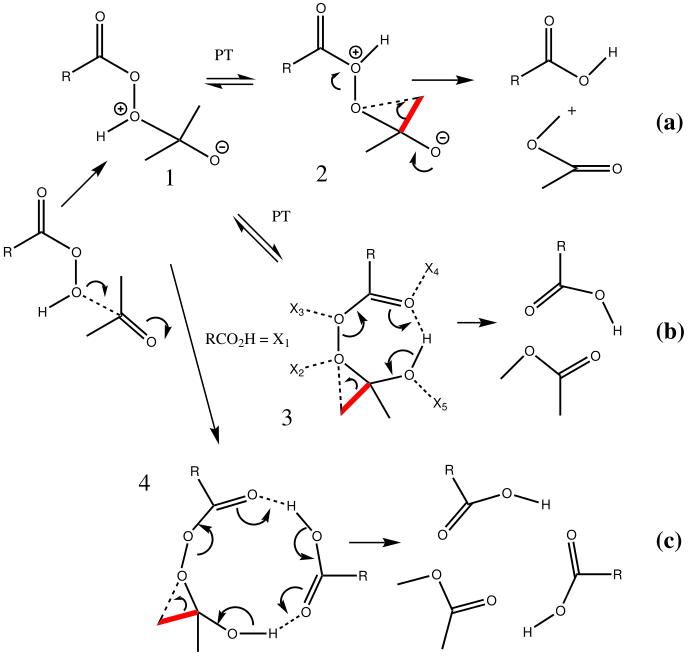
References
- J.R. Alvarez-Idaboy, L. Reyes, and N. Mora-Diez, "The mechanism of the Baeyer–Villiger rearrangement: quantum chemistry and TST study supported by experimental kinetic data", Organic & Biomolecular Chemistry, vol. 5, pp. 3682, 2007. https://doi.org/10.1039/b712608e