This is taking place in the idyllic surroundings of the Niederwald forest, Rüdesheim, Germany. Here I highlight only aspects of the first three talks.
π-Facial hydrogen bonds to alkynes (revisited): how close can an acidic hydrogen approach?
April 17th, 2017Following on from my re-investigation of close hydrogen bonding contacts to the π-face of alkenes, here now is an updated scan for H-bonds to alkynes. The search query (dataDOI: 10.14469/hpc/2478) is similar to the previous one:
π-Facial hydrogen bonds to alkenes (revisited): how close can an acidic hydrogen approach?
April 15th, 2017Back in the early 1990s, we first discovered the delights of searching crystal structures for unusual bonding features.[1] One of the first cases was a search for hydrogen bonds formed to the π-faces of alkenes and alkynes. In those days the CSD database of crystal structures was a lot smaller (<80,000 structures; it’s now ten times larger) and the search software less powerful. So here is an update.
References
- H.S. Rzepa, M.H. Smith, and M.L. Webb, "A crystallographic AM1 and PM3 SCF-MO investigation of strong OH ⋯π-alkene and alkyne hydrogen bonding interactions", J. Chem. Soc., Perkin Trans. 2, pp. 703-707, 1994. https://doi.org/10.1039/p29940000703
The π-π stacking of aromatic rings: what is their closest parallel approach?
April 13th, 2017Layer stacking in structures such as graphite is well-studied. The separation between the π-π planes is ~3.35Å, which is close to twice the estimated van der Waals (vdW) radius of carbon (1.7Å). But how much closer could such layers get, given that many other types of relatively weak interaction such as hydrogen bonding can contract the vdW distance sum by up to ~0.8Å or even more? This question was prompted by the separation calculated for the ion-pair cyclopropenium cyclopentadienide (~2.6-2.8Å).
The conformation of carboxylic acids revealed.
April 11th, 2017Following my conformational exploration of enols, here is one about a much more common molecule, a carboxylic acid.
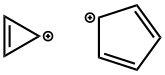
Cyclopropenium cyclopentadienide: a strangely neutral ion-pair?
April 9th, 2017Both the cyclopropenium cation and the cyclopentadienide anion are well-known 4n+2-type aromatic ions, but could the two together form an ion-pair?
The conformation of enols: revealed and explained.
April 6th, 2017Enols are simple compounds with an OH group as a substituent on a C=C double bond and with a very distinct conformational preference for the OH group. Here I take a look at this preference as revealed by crystal structures, with the theoretical explanation.
What is the (calculated) structure of a norbornyl cation anion-pair in water?
April 1st, 2017In a comment appended to an earlier post, I mused about the magnitude of the force constant relating to the interconversion between a classical and a non-classical structure for the norbornyl cation. Most calculations indicate the force constant for an “isolated” symmetrical cation is +ve, which means it is a true minimum and not a transition state for a [1,2] shift. The latter would have been required if the species equilibrated between two classical carbocations. I then pondered what might happen to both the magnitude and the sign of this force constant if various layers of solvation and eventually a counter-ion were to be applied to the molecule, so that a bridge of sorts between the different states of solid crystals, superacid and aqueous solutions might be built.