June 15th, 2019
The World-Wide-Web is currently celebrating its 30th anniversary; you can get the T-shirt in the CERN visitor centre! Five years on, in May 1994, the first Web conference took place (WWW94) at CERN and now celebrating its own 25th anniversary. That 1994 conference also had various break-out sessions, one of which summarised the state of chemistry on the web at the time. You can see my general but entirely personal impressions written after the workshop (DOI: 10.14469/hpc/5850), with a chemistry specific version at DOI: 10.14469/hpc/5851. A real trip down memory lane and an indication of how much has happened in 25 years!
Read the rest of this entry »
Posted in Interesting chemistry | 1 Comment »
June 5th, 2019
In August 2016, the launch of a chemistry pre-print service ChemRxiv was announced. I was phoned a day or so later by a staff journalist at C&E News for my opinion. The only comment that was retained for their report was my instantaneous feeling that “the community needed a chemistry pre-print server like one needed a hole in the head“. I had been there before you see, recollecting a pre-print server launched by the ChemWeb service around 1996 or 1997 and which lasted only about two years before being withdrawn due to the low quality of the preprints. So what do I think of ChemRxiv now in 2019?
Read the rest of this entry »
Posted in Interesting chemistry | 14 Comments »
June 2nd, 2019
This is a follow up to my earlier post about C⩸N+, itself inspired by this ChemRxiv pre-print[1] which describes a chemical synthesis of singlet biradicaloid C2 and its proposed identification as such by chemical trapping.
Read the rest of this entry »
References
- K. Miyamoto, S. Narita, Y. Masumoto, T. Hashishin, M. Kimura, M. Ochiai, and M. Uchiyama, "Room-Temperature Chemical Synthesis of C2", 2019. https://doi.org/10.26434/chemrxiv.8009633.v1
Posted in Interesting chemistry | No Comments »
May 27th, 2019
Although the small diatomic molecule known as dicarbon or C2 has been known for a long time, its properties and reactivity have really only been determined via its very high temperature generation. My interest started in 2010, when I speculatively proposed here that the related isoelectronic species C⩸N+ might sustain a quadruple bond. Shortly thereafter, a torrent of theoretical articles started to appear in which the idea of a quadruple bond to carbon was either supported or rejected. Clearly more experimental evidence was needed. The recent appearance of a Chemrxiv pre-print entitled “Room-temperature chemical synthesis of C2“.[1] claims to provide just this! Using the synthetic scheme outlined below, they trapped “C2” with a variety of reagents (see Figure 2A in their article), concluding that the observed reactivity best matched that of singlet “biradicaloid” C2 sustaining a quadruple bond.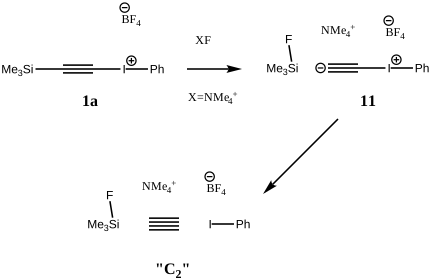
Read the rest of this entry »
References
- K. Miyamoto, S. Narita, Y. Masumoto, T. Hashishin, M. Kimura, M. Ochiai, and M. Uchiyama, "Room-Temperature Chemical Synthesis of C2", 2019. https://doi.org/10.26434/chemrxiv.8009633.v1
Posted in Interesting chemistry | 6 Comments »
May 2nd, 2019
Ken Houk’s group has recently published this study of cycloaddition reactions, using a combination of classical transition state location followed by molecular dynamics trajectory calculations,[1] and to which Steve Bachrach’s blog alerted me. The reaction struck me as being quite polar (with cyano groups) and so I took a look at the article to see what both the original[2] experimental conditions were and how the new simulations compared. The reaction itself is shown below.
Read the rest of this entry »
References
- X. Xue, C.S. Jamieson, M. Garcia-Borràs, X. Dong, Z. Yang, and K.N. Houk, "Ambimodal Trispericyclic Transition State and Dynamic Control of Periselectivity", Journal of the American Chemical Society, vol. 141, pp. 1217-1221, 2019. https://doi.org/10.1021/jacs.8b12674
- C.Y. Liu, and S.T. Ding, "Cycloadditions of electron-deficient 8,8-disubstituted heptafulvenes to electron-rich 6,6-disubstituted fulvenes", The Journal of Organic Chemistry, vol. 57, pp. 4539-4544, 1992. https://doi.org/10.1021/jo00042a039
Tags: Chemistry, computational chemistry, Implicit solvation, Ken Houk, Molecular dynamics, Molecular modelling, Natural sciences, Physical sciences, Solutions, Solvent, Solvent model, Solvents, Steve Bachrach, Theoretical chemistry
Posted in reaction mechanism | 2 Comments »
April 25th, 2019
Previously, I explored (computationally) the normal vibrational modes of Co(II)-tetraphenylporphyrin (CoTPP) as a “flattened” species on copper or gold surfaces for comparison with those recently imaged[1]. The initial intent was to estimate the “flattening” energy. There are six electronic possibilities for this molecule on a metal surface. Respectively positively, or negatively charged and a neutral species, each in either a low or a high-spin electronic state. I reported five of these earlier, finding each had quite high barriers for “flattening” the molecule. For the final 6th possibility, the triplet anion, the SCF (self-consistent-field) had failed to converge, but for which I can now report converged results.†
Read the rest of this entry »
References
- J. Lee, K.T. Crampton, N. Tallarida, and V.A. Apkarian, "Visualizing vibrational normal modes of a single molecule with atomically confined light", Nature, vol. 568, pp. 78-82, 2019. https://doi.org/10.1038/s41586-019-1059-9
Tags: 019-1059-9, 10.1038, Biomolecules, Chelating agents, chemical bonding, Chemical compounds, Chemistry, Coordination chemistry, Coordination complex, Copper, copper metal surface, Cu–CO, E-type, energy, free energy, higher energy, impossible free energy, Inorganic chemistry, Jahn–Teller effect, lowest energy electronic state, Metabolism, metal, metal surface, modest planarisation energy, Molecule, Natural sciences, Physical sciences, planarisation, Porphyrin, reasonable energy, Resonance, Solid-state chemistry, sufficient energy, Teller, Tetraphenylporphyrin
Posted in Interesting chemistry | 1 Comment »
April 18th, 2019
Tags: Academic publishing, automatic processing, Data management, Digital Object Identifier, EIDR, FAIR data, Findability, Identifiers, Information, Information architecture, Information science, Knowledge, Knowledge representation, metadata, mining, Open Archives Initiative, RDF, Records management, representative, standardized communication protocol, Technical communication, Technology/Internet, Web design, Written communication, XML
Posted in Chemical IT | No Comments »
April 18th, 2019
The topic of this post originates from a recent article which is attracting much attention.[1] The technique uses confined light to both increase the spatial resolution by around three orders of magnitude and also to amplify the signal from individual molecules to the point it can be recorded. To me, Figure 3 in this article summarises it nicely (caption: visualization of vibrational normal modes). Here I intend to show selected modes as animated and rotatable 3D models with the help of their calculation using density functional theory (a mode of presentation that the confinement of Figure 3 to the pages of a conventional journal article does not enable).
Read the rest of this entry »
References
- J. Lee, K.T. Crampton, N. Tallarida, and V.A. Apkarian, "Visualizing vibrational normal modes of a single molecule with atomically confined light", Nature, vol. 568, pp. 78-82, 2019. https://doi.org/10.1038/s41586-019-1059-9
Tags: anionic metal surface, Cambridge, chemical bonding, Chemistry, dihedral, energy, flat metal surface, metal, Natural sciences, Neutral Quartet, Physical sciences, Raman scattering, Raman spectroscopy, Resonance, spectroscopy, steric repulsion energy
Posted in Interesting chemistry | No Comments »
April 12th, 2019
In recent years, findable data has become ever more important (the F in FAIR). Here I test that F using the DataCite search service.
Read the rest of this entry »
Tags: Academic publishing, DataCite, Digital Object Identifier, Digital technology, Elsevier, Findability, Identifiers, Information, Information architecture, Information science, Knowledge, Knowledge representation, search service, Web design
Posted in Chemical IT | 1 Comment »
April 8th, 2019
The conventional procedures for reporting analysis or new results in science is to compose an “article”, augment that perhaps with “supporting information” or “SI”, submit to a journal which undertakes peer review, with revision as necessary for acceptance and finally publication. If errors in the original are later identified, a separate corrigendum can be submitted to the same journal, although this is relatively rare. Any new information which appears post-publication is then considered for a new article, and the cycle continues. Here I consider the possibilities for variations in this sequence of events.
Read the rest of this entry »
Tags: Academic publishing, American Chemical Society, author, Business intelligence, Company: DataCite, CrossRef, data, Data management, DataCite, editor, EIDR, Information, Information science, JSON, Knowledge representation, Metadata repository, Records management, Technology/Internet, The Metadata Company
Posted in Chemical IT | No Comments »