May 7th, 2012
The Baeyer-Villiger rearrangement was named after its discoverers, who in 1899 described the transformation of menthone into the corresponding lactone using Caro’s acid (peroxysulfuric acid). The mechanism is described in all text books of organic chemistry as involving an alkyl migration. Here I take a look at the scheme described by Alvarez-Idaboy, Reyes and Mora-Diez[1], and which may well not yet have made it to all the text books!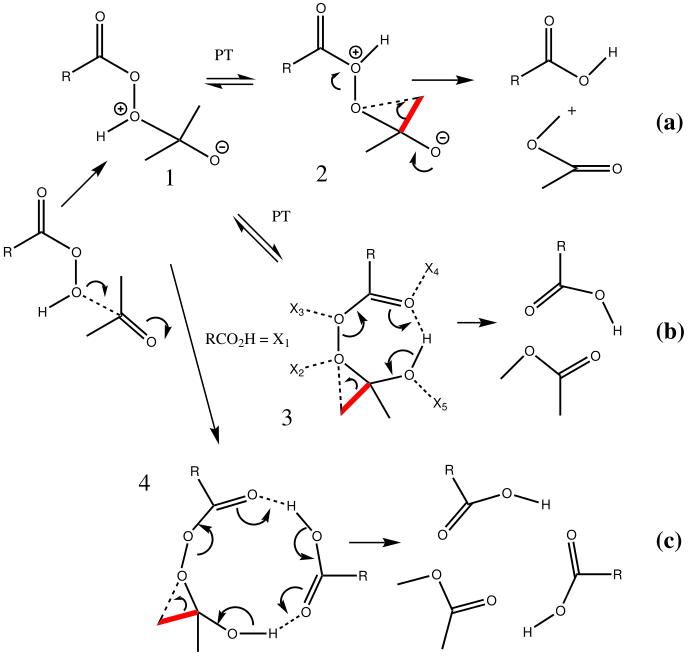
Read the rest of this entry »
References
- J.R. Alvarez-Idaboy, L. Reyes, and N. Mora-Diez, "The mechanism of the Baeyer–Villiger rearrangement: quantum chemistry and TST study supported by experimental kinetic data", Organic & Biomolecular Chemistry, vol. 5, pp. 3682, 2007. https://doi.org/10.1039/b712608e
Tags: final product, free energy, Historical, stereoelectronic, Tutorial material, X5
Posted in reaction mechanism | 6 Comments »
April 30th, 2012
During the 1960s, a holy grail of synthetic chemists was to devise an efficient route to steroids. R. B. Woodward was one the chemists who undertook this challenge, starting from compounds known as dienones (e.g. 1) and their mysterious conversion to phenols (e.g. 2 or 3) under acidic conditions. This was also the golden era of mechanistic exploration, which coupled with an abundance of radioactive isotopes from the war effort had ignited the great dienone-phenol debates of that time (now largely forgotten). In a classic recording from the late 1970s, Woodward muses how chemistry had changed since he started in the early 1940s. In particular he notes how crystallography had revolutionised the reliability and speed of molecular structure determination. Here I speculate what he might have made of modern computational chemistry, and in particular whether it might cast new light on those mechanistic controversies of the past.
Read the rest of this entry »
Tags: computational chemist, computational chemistry, Historical, pericyclic, sigmatropic shifts, tracer labelling
Posted in Chemical IT, Interesting chemistry | 1 Comment »
April 22nd, 2012
Astronomers who discover an asteroid get to name it, mathematicians have theorems named after them. Synthetic chemists get to name molecules (Hector’s base and Meldrum’s acid spring to mind) and reactions between them. What do computational chemists get to name? Transition states! One of the most famous of recent years is the Houk-List.
Read the rest of this entry »
Tags: catalysis, condensation, energy, gas-phase optimised geometry, Historical, Houk-List, smallest steric exchange energy, so-called single-point solvation energy correction, steric exchange energy
Posted in Interesting chemistry | 4 Comments »
April 6th, 2012
Chemists love a mystery as much as anyone. And gaps in patterns can be mysterious. Mendeleev’s period table had famous gaps which led to new discovery. And so from the 1890s onwards, chemists searched for the perbromate anion, BrO4–. It represented a gap between perchlorate and periodate, both of which had long been known. As the failure to turn up perbromate persisted, the riddle deepened. Finally, in 1968, the key was found, but talk about sledgehammer to crack a nut! It was done by alchemical-like radioactive transmutation of selenium into bromine:
Read the rest of this entry »
Tags: alkaline sodium hypobromite solution, chemical synthesis, Historical, metal catalysis, present chemical knowledge, speculative chemist
Posted in Interesting chemistry | No Comments »
April 2nd, 2012
I mentioned in my last post an unjustly neglected paper from that golden age of 1951-1953 by Kirkwood and co. They had shown that Fischer’s famous guess for the absolute configurations of organic chiral molecules was correct. The two molecules used to infer this are shown below.
Read the rest of this entry »
Tags: dichloropropane, epoxybutene, gas phase, Historical, Kirkwood and co., optical rotation, pharmaceutical synthesis, spectroscopy
Posted in Chiroptics, Historical | No Comments »
March 13th, 2012
I wrote in an earlier post how Pauling’s Nobel prize-winning suggestion in February 1951 of a (left-handed) α-helical structure for proteins[1] was based on the wrong absolute configuration of the amino acids (hence his helix should really have been the right-handed enantiomer). This was most famously established a few months later by Bijvoet’s[2] definitive crystallographic determination of the absolute configuration of rubidium tartrate, published on August 18th, 1951 (there is no received date, but a preliminary communication of this result was made in April 1950). Well, a colleague (thanks Chris!) just wandered into my office and he drew my attention to an article by John Kirkwood[3] published in April 1952, but received July 20, 1951,‡ carrying the assertion “The Fischer convention is confirmed as a structurally correct representation of absolute configuration“, and based on the two compounds 2,3-epoxybutane and 1,2-dichloropropane. Neither Bijvoet nor Kirkwood seem aware of the other’s work, which was based on crystallography for the first, and quantum computation for the second. Over the years, the first result has become the more famous, perhaps because Bijvoet’s result was mentioned early on by Watson and Crick in their own very famous 1953 publication of the helical structure of DNA. They do not mention Kirkwood’s result. Had they not been familiar with Bijvoet’s[2] result, their helix too might have turned out a left-handed one!
Read the rest of this entry »
References
- L. Pauling, R.B. Corey, and H.R. Branson, "The structure of proteins: Two hydrogen-bonded helical configurations of the polypeptide chain", Proceedings of the National Academy of Sciences, vol. 37, pp. 205-211, 1951. https://doi.org/10.1073/pnas.37.4.205
- J.M. BIJVOET, A.F. PEERDEMAN, and A.J. van BOMMEL, "Determination of the Absolute Configuration of Optically Active Compounds by Means of X-Rays", Nature, vol. 168, pp. 271-272, 1951. https://doi.org/10.1038/168271a0
- W.W. Wood, W. Fickett, and J.G. Kirkwood, "The Absolute Configuration of Optically Active Molecules", The Journal of Chemical Physics, vol. 20, pp. 561-568, 1952. https://doi.org/10.1063/1.1700491
Tags: California, chiroptical spectroscopies, computational chemistry, Imperial College, Institute of Technology, John Kirkwood, Pasadena, spectroscopy
Posted in Chiroptics, Historical | 1 Comment »
March 9th, 2012
The equilibrium for the hydration of a ketone to form a gem-diol hydrate is known to be highly sensitive to substituents. Consider the two equilibria:
Read the rest of this entry »
Tags: anomeric effects, ELF, free energy difference, interaction energy, NBO, O Lp, Tutorial material
Posted in Interesting chemistry | 2 Comments »
February 27th, 2012
Sometimes, as a break from describing chemistry, I take to describing the (chemical/scientific) creations behind the (WordPress) blog system. It is fascinating how there do seem increasing signs of convergence between the blog post and the journal article. Perhaps prompted by transclusion of tools such as Jmol and LaTex into Wikis and blogs, I list the following interesting developments in both genres.
Read the rest of this entry »
Tags: API, chemical terms, chemical/science-savvy blog, chemical/scientific, citation management, Digital Object Identifier, Dublin, Java, LaTex, Skolnik, Sometimes
Posted in Chemical IT | 2 Comments »
February 26th, 2012
One thing almost always leads to another in chemistry. In the last post, I described how an antiperiplanar migration could compete with an antiperiplanar elimination. This leads to the hydroboration-oxidation mechanism, the discovery of which resulted in Herbert C. Brown (at least in part) being awarded the Nobel prize in 1979. Read the rest of this entry »
Tags: Tutorial material
Posted in Uncategorised | 10 Comments »