Following on from our first mechanistic reality check, we now need to verify how product A might arise in the mechanism shown below, starting from B.
Archive for October, 2012
Secrets of a university tutor. An exercise in mechanistic logic: second dénouement.
Monday, October 29th, 2012Secrets of a university tutor. An exercise in mechanistic logic: first dénouement.
Sunday, October 28th, 2012The reaction described in the previous post (below) is an unusual example of nucleophilic attack at an sp2-carbon centre, reportedly resulting in inversion of configuration[1]. One can break it down to a sequence of up to eight individual steps, which makes teaching it far easier. But how real is that sequence?
References
- T.C. Clarke, and R.G. Bergman, "Olefinic cyclization at a vinyl cation center. Inversion preference for intramolecular nucleophilic substitution by a double bond", Journal of the American Chemical Society, vol. 94, pp. 3627-3629, 1972. https://doi.org/10.1021/ja00765a062
Secrets of a university tutor. An exercise in mechanistic logic, prequel.
Saturday, October 27th, 2012The reaction below plays a special role in my career. As a newly appointed researcher (way back now), I was asked to take tutorial groups for organic chemistry as part of my duties. I sat down to devise a suitable challenge for the group, and came upon the following reaction[1]. I wrote it down on page 2 of my tutorial book, which I still have. I continue to use this example in tutorials to this day, some 35 years later.
References
- T.C. Clarke, and R.G. Bergman, "Olefinic cyclization at a vinyl cation center. Inversion preference for intramolecular nucleophilic substitution by a double bond", Journal of the American Chemical Society, vol. 94, pp. 3627-3629, 1972. https://doi.org/10.1021/ja00765a062
How is the bromination of alkenes best represented?
Sunday, October 14th, 2012I occasionally delve into the past I try to understand how we got to our present understanding of chemistry. Thus curly arrow mechanistic notation can be traced back to around 1924, with style that bifurcated into two common types used nowadays (on which I have commented and about which further historical light at the end of this post). Here I try to combine these themes with some analysis of wavefunctions for a particularly troublesome reaction to represent, the dibromination of an alkene, which I represented in the previous post as shown below.
Text-books and the bromination of ethene.
Sunday, October 14th, 2012There is often a disconnect between how a text-book (schematically) represents a reaction and a more quantitive “reality” revealed by quantum mechanics. Is the bromination of ethene to give 1,2-dibromoethane one such example?
Ring-flipping in cyclohexane in a different light
Friday, October 12th, 2012The conformational analysis of cyclohexane is a mainstay of organic chemistry. Is there anything new that can be said about it? Let us start with the diagram below:
Alkyne metathesis: a comparison with alkene metathesis.
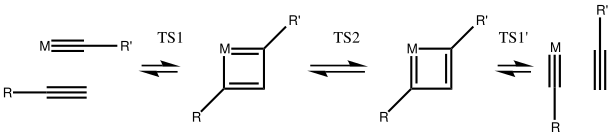
Monday, October 8th, 2012Metathesis reactions are a series of catalysed transformations which transpose the atoms in alkenes or alkynes. Alkyne metathesis is closely related to the same reaction for alkenes, and one catalyst that is specific to alkynes was introduced by Schrock (who with Grubbs won the Nobel prize for these discoveries) and is based on tungsten (M=W(OR)3).