The mechanism of the reaction of alkenes known as ozonolysis was first set out in its modern form by Criegee. The crucial steps, (a), (b) and (d), are all pericyclic cycloaddition/eliminations. The last step (e) is known as reductive ozonolysis, and this step is often treated as an afterthought, part of the work-up of the reaction if you like (it is not illustrated in Criegee’s review for example). Here, I will attempt to show that it is actually a very interesting mechanistic step.
Archive for May 7th, 2012
Reductive ozonolysis: the interesting step.
Monday, May 7th, 2012The mechanism of the Baeyer-Villiger rearrangement.
Monday, May 7th, 2012The Baeyer-Villiger rearrangement was named after its discoverers, who in 1899 described the transformation of menthone into the corresponding lactone using Caro’s acid (peroxysulfuric acid). The mechanism is described in all text books of organic chemistry as involving an alkyl migration. Here I take a look at the scheme described by Alvarez-Idaboy, Reyes and Mora-Diez[1], and which may well not yet have made it to all the text books!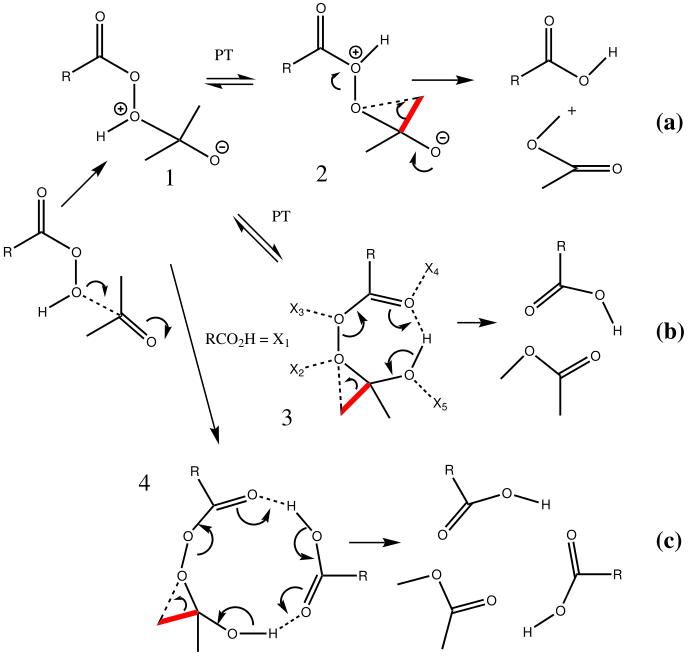
References
- J.R. Alvarez-Idaboy, L. Reyes, and N. Mora-Diez, "The mechanism of the Baeyer–Villiger rearrangement: quantum chemistry and TST study supported by experimental kinetic data", Organic & Biomolecular Chemistry, vol. 5, pp. 3682, 2007. https://doi.org/10.1039/b712608e