This comes to you from China, and the city of Suzhou. To set the scene, cities in China have a lot of motorbikes. Electric ones. With their own speed units, a % of Panda speed. 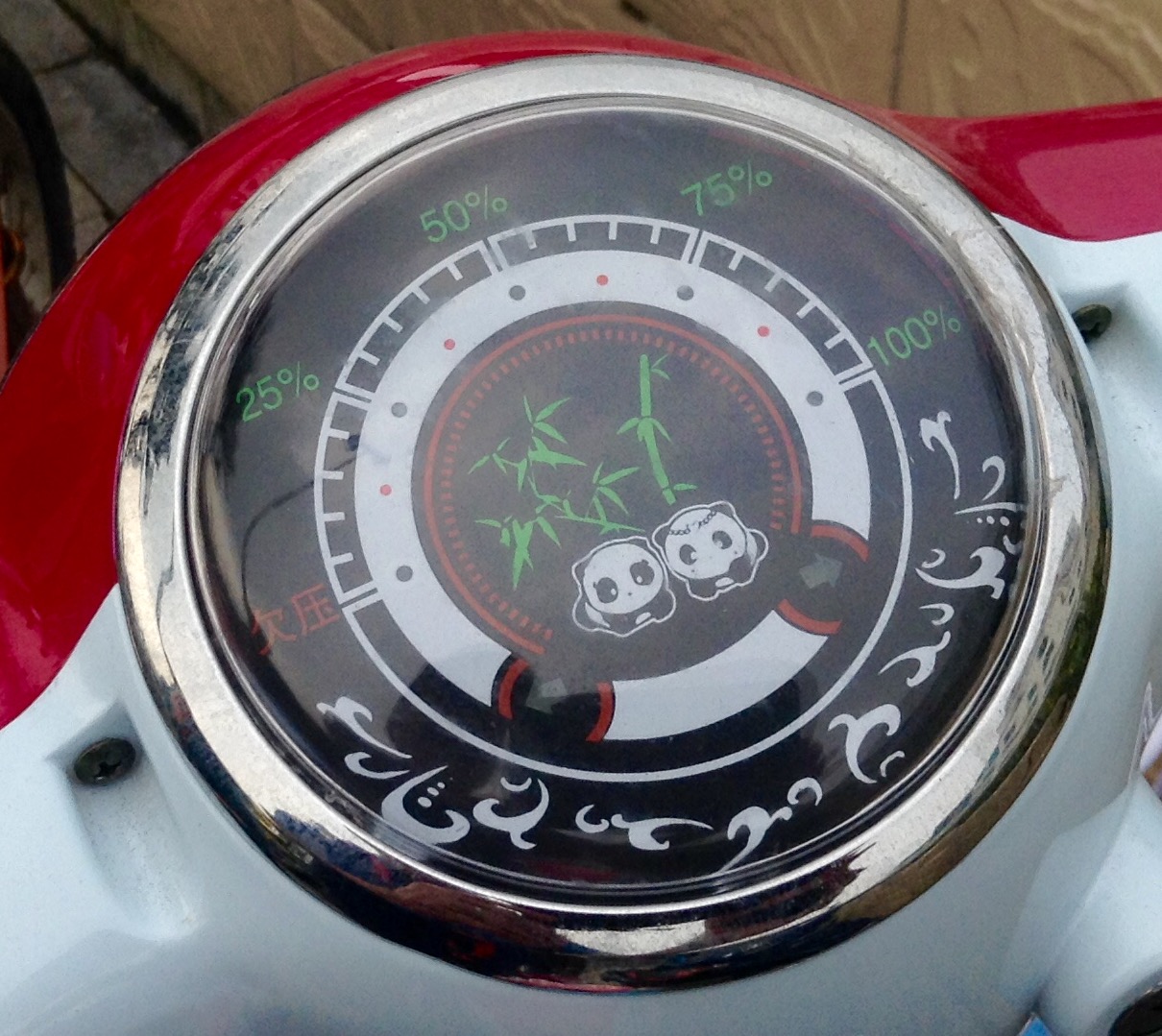
Archive for the ‘Interesting chemistry’ Category
Impressions of China. New units of speed and old ways of counting.
Friday, October 9th, 2015Isoelectronic games: the CO analogue of diazirines as an intriguing species?
Thursday, September 24th, 2015How does an anaesthetic work? Surprisingly, it is only recently[1] that the possible binding sites of the anaesthetic propofol (2,6-di-isopropylphenol) have been identified using a technique known as photoaffinity labelling.[2] A propofol analogue was constructed[1] by replacing one of the isopropyl groups with a trifluoromethyl diazirine group (R=CF3, X=Y=N below). Upon photolysis, this species looses nitrogen and forms a carbene as a reactive species, which with further chemistry binds covalently[2] to adjacent amino acids in the binding pocket.These modified segments could then be analysed by mass spectrometry.[1] An isomer of diazirine is diazomethane, which is some 11 kcal/mol lower in free energy, but fortunately the diazirene is preventing from thermally isomerising to this species by a large kinetic barrier. That was the intro; now for a connection.‡ I recently attended a presentation on another medical topic, the therapeutic uses of carbon monoxide.[3] In higher concentrations it is notoriously lethal, but with appropriate delivery it can be therapeutic. So, intertwingling, I asked myself what the properties of the carbon monoxide isoelectronic analogue of a diazirine might be (X=C, Y=O below).
References
- G.M.S. Yip, Z. Chen, C.J. Edge, E.H. Smith, R. Dickinson, E. Hohenester, R.R. Townsend, K. Fuchs, W. Sieghart, A.S. Evers, and N.P. Franks, "A propofol binding site on mammalian GABAA receptors identified by photolabeling", Nature Chemical Biology, vol. 9, pp. 715-720, 2013. https://doi.org/10.1038/nchembio.1340
- L. Dubinsky, B.P. Krom, and M.M. Meijler, "Diazirine based photoaffinity labeling", Bioorganic & Medicinal Chemistry, vol. 20, pp. 554-570, 2012. https://doi.org/10.1016/j.bmc.2011.06.066
- R. Motterlini, and L.E. Otterbein, "The therapeutic potential of carbon monoxide", Nature Reviews Drug Discovery, vol. 9, pp. 728-743, 2010. https://doi.org/10.1038/nrd3228
Intermolecular atom-atom bonds in crystals? The O…O case.
Saturday, July 25th, 2015I recently followed this bloggers trail; link1 → link2 to arrive at this delightful short commentary on atom-atom bonds in crystals[1] by Jack Dunitz. Here he discusses that age-old question (to chemists), what is a bond? Even almost 100 years after Gilbert Lewis’ famous analysis,[2] we continue to ponder this question. Indeed, quite a debate on this topic broke out in a recent post here. My eye was caught by one example in Jack's article: "The close stacking of planar anions, as occurs in salts of croconic acid …far from producing a lowering of the crystal energy, this stacking interaction in itself leads to an increase by several thousand kJ mol−1 arising from Coulombic repulsion between the doubly negatively charged anions" I thought I might explore this point a bit further in this post.
References
- J.D. Dunitz, "Intermolecular atom–atom bonds in crystals?", IUCrJ, vol. 2, pp. 157-158, 2015. https://doi.org/10.1107/s2052252515002006
- G.N. Lewis, "THE ATOM AND THE MOLECULE.", Journal of the American Chemical Society, vol. 38, pp. 762-785, 1916. https://doi.org/10.1021/ja02261a002
Electrides (aka solvated electrons).
Wednesday, July 8th, 2015Peter Edwards has just given the 2015 Hofmann lecture here at Imperial on the topic of solvated electrons. An organic chemist knows this species as “e–” and it occurs in ionic compounds known as electrides; chloride = the negative anion of a chlorine atom, hence electride = the negative anion of an electron. It struck me how very odd these molecules are and so I thought I might share here some properties I computed after the lecture for a specific electride known as GAVKIS.[1] If you really want to learn (almost) everything about these strange species, go read the wonderful review by Zurek, Edwards and Hoffmann,[2] including a lesson in the history of chemistry stretching back almost 200 years.
References
- D.L. Ward, R.H. Huang, and J.L. Dye, "Structures of alkalides and electrides. I. Structure of potassium cryptand[2.2.2] electride", Acta Crystallographica Section C Crystal Structure Communications, vol. 44, pp. 1374-1376, 1988. https://doi.org/10.1107/s0108270188002847
- E. Zurek, P. Edwards, and R. Hoffmann, "A Molecular Perspective on Lithium–Ammonia Solutions", Angewandte Chemie International Edition, vol. 48, pp. 8198-8232, 2009. https://doi.org/10.1002/anie.200900373
R-X≡X-R: G. N. Lewis’ 100 year old idea.
Friday, May 22nd, 2015As I have noted elsewhere, Gilbert N. Lewis wrote a famous paper entitled “the atom and the molecule“, the centenary of which is coming up.[1] In a short and rarely commented upon remark, he speculates about the shared electron pair structure of acetylene, R-X≡X-R (R=H, X=C). It could, he suggests, take up three forms. H-C:::C-H and two more which I show as he drew them. The first of these would now be called a bis-carbene and the second a biradical.
References
- G.N. Lewis, "THE ATOM AND THE MOLECULE.", Journal of the American Chemical Society, vol. 38, pp. 762-785, 1916. https://doi.org/10.1021/ja02261a002
Ionizing yet more ultra-strong acids with water molecules.
Friday, March 20th, 2015This might be seen as cranking a handle by producing yet more examples of acids ionised by a small number of water molecules. I justify it (probably only to myself) as an exercise in how a scientist might approach a problem, and how it linearly develops with time, not necessarily in the directions first envisaged. A conventional scientific narrative published in a conventional journal tells the story often with the benefit of hindsight, but rarely how the project actually unfolded chronologically.‡ So by devoting 7 posts to this, you can judge for yourself how my thoughts might have developed (and I am prepared to acknowledge this may only serve to show my ignorance).
A 5-high straight flush of water-ionised acids?
Tuesday, March 17th, 2015I do not play poker,‡ and so I had to look up a 5-4-3-2-1(A), which Wikipedia informs me is a 5-high straight flush, also apparently known as a steel wheel. In previous posts I have suggested acids which can be ionised by (probably) 5, 4, 3 or 1 discrete water molecules in the gas phase; now to try to track down a candidate for ionisation by the required two water molecules to form that straight flush.
Ionizing ultra-strong acids with water molecules.
Sunday, March 15th, 2015My previous posts have covered the ionization by a small number of discrete water molecules of the series of halogen acids, ranging from HI (the strongest, pKa -10) via HF (weaker, pKa 3.1) to the pseudo-halogen HCN (the weakest, pKa 9.2). Here I try out some even stronger acids to see what the least number of water molecule needed to ionize these might be.
How many water molecules does it take to ionise HCN/HNC? An NCI exploration.
Monday, March 2nd, 2015HCN is a weak acid (pKa +9.2, weaker than e.g. HF), although it does have an isomer, isocyanic acid or HNC (pka < +9.2 ?) which is simultaneously stronger and less stable. I conclude my halide acid series by investigating how many water molecules (in gas phase clusters) are required for ionisation of this “pseudo-halogen” acid.