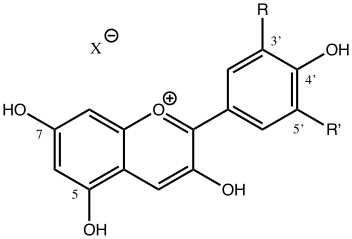
It was about a year ago that I came across a profusion of colour in my local Park. Although colour in fact was the topic that sparked my interest in chemistry many years ago (the fantastic reds produced by diazocoupling reactions), I had never really tracked down the origin of colours in many flowers. It is of course a vast field. Here I take a look at just one class of molecule responsible for many flower colours, anthocyanidin, this being the sugar-free counterpart of the anthocyanins found in nature.
Archive for the ‘Interesting chemistry’ Category
Why do flowers such as roses, peonies, dahlias, delphiniums (etc), exhibit so many shades of colours?
Monday, June 18th, 2018Examples please of FAIR (data); good and bad.
Sunday, May 6th, 2018The site fairsharing.org is a repository of information about FAIR (Findable, Accessible, Interoperable and Reusable) objects such as research data.

Aromaticity-induced basicity.
Wednesday, April 18th, 2018The molecules below were discussed in the previous post as examples of highly polar but formally neutral molecules, a property induced by aromatisation of up to three rings. Since e.g. compound 3 is known only in its protonated phenolic form, here I take a look at the basicity of the oxygen in these systems to see if deprotonation of the ionic phenol form to the neutral polar form is viable.
A record polarity for a neutral compound?
Friday, April 13th, 2018In several posts a year or so ago I considered various suggestions for the most polar neutral molecules, as measured by the dipole moment. A record had been claimed[1] for a synthesized molecule of ~14.1±0.7D. I pushed this to a calculated 21.7D for an admittedly hypothetical and unsynthesized molecule. Here I propose a new family of compounds which have the potential to extend the dipole moment for a formally neutral molecule up still further.
References
- J. Wudarczyk, G. Papamokos, V. Margaritis, D. Schollmeyer, F. Hinkel, M. Baumgarten, G. Floudas, and K. Müllen, "Hexasubstituted Benzenes with Ultrastrong Dipole Moments", Angewandte Chemie International Edition, vol. 55, pp. 3220-3223, 2016. https://doi.org/10.1002/anie.201508249
The dark satanic mills (of the industrial revolution?)
Sunday, March 18th, 2018Around the time of the 2012 olympic games, the main site for which was Stratford in east London, I heard a fascinating talk about the “remediation” of the site from the pollution caused by its industrial chemical heritage. Here I visit another, arguably much more famous and indeed older industrial site.
Is (hν)3 an allotrope of light?
Friday, February 23rd, 2018A little while ago I pondered allotropic bromine, or Br(Br)3. But this is a far wackier report[1] of a molecule of light.
References
- Q. Liang, A.V. Venkatramani, S.H. Cantu, T.L. Nicholson, M.J. Gullans, A.V. Gorshkov, J.D. Thompson, C. Chin, M.D. Lukin, and V. Vuletić, "Observation of three-photon bound states in a quantum nonlinear medium", Science, vol. 359, pp. 783-786, 2018. https://doi.org/10.1126/science.aao7293
London: set to become a National Park City in 2019.
Friday, February 9th, 2018Last year, I showed photos of wildflower meadows in west London close to where we live, evolving as the seasons changed. Today we hear the announcement that London itself is set be declared the world’s first National Park City in 2019.