Archive for the ‘Interesting chemistry’ Category
Tuesday, November 20th, 2012
More than 60 million molecules are known, and many are fascinating. But beauty is in the eye of the beholder. Thus it was that I came across the attached molecule[1]. It struck me immediately as, well, beautiful!
(more…)
References
- S. Lai, T. Lin, Y. Chen, C. Wang, G. Lee, M. Yang, M. Leung, and S. Peng, "Metal String Complexes: Synthesis and Crystal Structure of [Ni<sub>4</sub>(μ<sub>4</sub>-phdpda)<sub>4</sub>] and [Ni<sub>7</sub>(μ<sub>7</sub>-teptra)<sub>4</sub>Cl<sub>2</sub>] (H<sub>2</sub>phdpda = <i>N</i>-Phenyldipyridyldiamine and H<sub>3</sub>teptra = Tetrapyridyltriamine)", Journal of the American Chemical Society, vol. 121, pp. 250-251, 1998. https://doi.org/10.1021/ja982065w
Tags:metal wire
Posted in Interesting chemistry | 2 Comments »
Sunday, November 18th, 2012
A game chemists often play is to guess the mechanism for any given reaction. I thought I would give it a go for the decomposition of the tris-peroxide shown below. This reaction is known to (rapidly, very rapidly) result in the production of three molecules of propanone, one of ozone and a lot of entropy (but not heat).[1]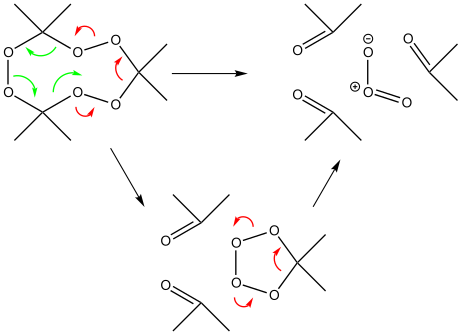
(more…)
References
- F. Dubnikova, R. Kosloff, J. Almog, Y. Zeiri, R. Boese, H. Itzhaky, A. Alt, and E. Keinan, "Decomposition of Triacetone Triperoxide Is an Entropic Explosion", Journal of the American Chemical Society, vol. 127, pp. 1146-1159, 2005. https://doi.org/10.1021/ja0464903
Tags:free energy, lower energy saddle point, Reaction Mechanism
Posted in Interesting chemistry | No Comments »
Saturday, November 10th, 2012
Thalidomide is a chiral molecule, which was sold in the 1960s as a sedative in its (S,R)-racemic form. The tragedy was that the (S)-isomer was tetragenic, and only the (R) enantiomer acts as a sedative. What was not appreciated at the time is that interconversion of the (S)- and (R) forms takes place quite quickly in aqueous media. Nowadays, quantum modelling can provide good in-silico estimates of the (free) energy barriers for such processes, which in this case is a simple keto-enol tautomerism. In a recently published article[1], just such a simulation is reported. By involving two explicit water molecules in the transition state, an (~enthalpic) barrier of 27.7 kcal/mol was obtained. The simulation was conducted just with two water molecules acting as solvent, and without any additional continuum solvation applied. So I thought I would re-evaluate this result by computing it at the ωB97XD/6-311G(d,p)/SCRF=water level (a triple-ζ basis set rather than the double-ζ used before[1]), and employing a dispersion-corrected DFT method rather than B3LYP. 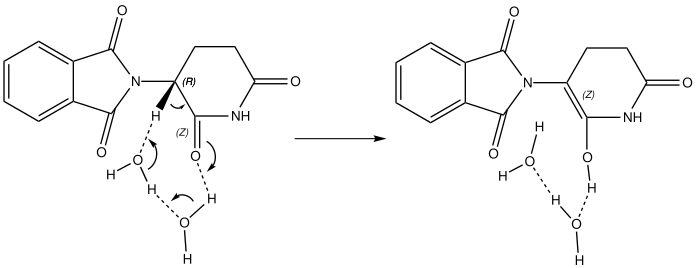
(more…)
References
- C. Tian, P. Xiu, Y. Meng, W. Zhao, Z. Wang, and R. Zhou, "Enantiomerization Mechanism of Thalidomide and the Role of Water and Hydroxide Ions", Chemistry – A European Journal, vol. 18, pp. 14305-14313, 2012. https://doi.org/10.1002/chem.201202651
Tags:298 4.7, aqueous media, ATM, energy barrier, energy barriers, free energy, Historical, Reaction Mechanism, simulation, zero-point-energy
Posted in Interesting chemistry | 1 Comment »
Sunday, November 4th, 2012
When methyl manganese pentacarbonyl is treated with carbon monoxide in e.g. di-n-butyl ether, acetyl manganese pentacarbonyl is formed. This classic experiment conducted by Cotton (of quadruple bond fame) and Calderazzo in 1962[1] dates from an era when chemists conducted extensive kinetic analyses to back up any mechanistic speculations. Their suggested transition state is outlined below. Here I subject their speculations to a quantum mechanical “reality check“.
(more…)
References
- F. Calderazzo, and F.A. Cotton, "Carbon Monoxide Insertion Reactions. I. The Carbonylation of Methyl Manganese Pentacarbonyl and Decarbonylation of Acetyl Manganese Pentacarbonyl", Inorganic Chemistry, vol. 1, pp. 30-36, 1962. https://doi.org/10.1021/ic50001a008
Tags:agostic interaction, pi complex, Reaction Mechanism
Posted in Interesting chemistry | 1 Comment »
Sunday, October 28th, 2012
The reaction described in the previous post (below) is an unusual example of nucleophilic attack at an sp2-carbon centre, reportedly resulting in inversion of configuration[1]. One can break it down to a sequence of up to eight individual steps, which makes teaching it far easier. But how real is that sequence?
(more…)
References
- T.C. Clarke, and R.G. Bergman, "Olefinic cyclization at a vinyl cation center. Inversion preference for intramolecular nucleophilic substitution by a double bond", Journal of the American Chemical Society, vol. 94, pp. 3627-3629, 1972. https://doi.org/10.1021/ja00765a062
Tags:immediate product, inversion, Reaction Mechanism, triflate leaving, Tutorial material, vinyl carbocation
Posted in Interesting chemistry | 1 Comment »
Wednesday, October 17th, 2012
Every once in a while, one encounters a molecule which instantly makes an interesting point. Thus Ruthenium is ten electrons short of completing an 18-electron shell, and it can form a complex with benzene on one face and a ligand known as trimethylenemethane on the other[1].
(more…)
References
- G.E. Herberich, and T.P. Spaniol, "Trimethylenemethane complexes of ruthenium via the trimethylenemethane dianion", Journal of the Chemical Society, Chemical Communications, pp. 1457, 1991. https://doi.org/10.1039/c39910001457
Tags:Iron complex, metal, Postscript
Posted in Interesting chemistry | No Comments »
Monday, October 8th, 2012
Metathesis reactions are a series of catalysed transformations which transpose the atoms in alkenes or alkynes. Alkyne metathesis is closely related to the same reaction for alkenes, and one catalyst that is specific to alkynes was introduced by Schrock (who with Grubbs won the Nobel prize for these discoveries) and is based on tungsten (M=W(OR)3).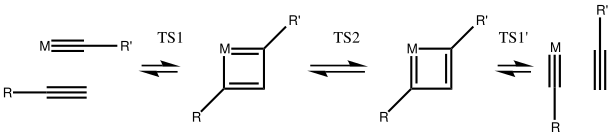
(more…)
Tags:Reaction Mechanism, X-ray
Posted in Interesting chemistry | No Comments »