My previous two posts on the topic of strongest bonds have involved mono and diprotonating N2 and using quantum mechanics to predict the effect this has on the N-N bond via its length and vibrational stetching mode. Such species are very unlikely to be easily observed for verification. But how about a metal M+ instead of H+? It turns out that structures containing the fragment Ru-N≡N-Ru are a small but well studied class of organometallic. Here is a search of the CSD crystal database for this motif.
Archive for the ‘crystal_structure_mining’ Category
The strongest bond in the universe: A crystallographic reality check?
Monday, May 25th, 2020A molecular sponge for hydrogen storage- the future for road transport?
Sunday, April 19th, 2020In the news this week is a report of a molecule whose crystal lattice is capable of both storing and releasing large amounts of hydrogen gas at modest pressures and temperatures. Thus “NU-1501-Al” can absorb 14 weight% of hydrogen. To power a low-polluting car with a 500 km range, about 4-5 kg of hydrogen gas would be need to be stored and released safely. The molecule is of interest since it opens a systematic strategy of synthetically driven optimisation towards a viable ultra-porous storage material,[1] much like a lead drug compound can be optimised.
References
- Z. Chen, P. Li, R. Anderson, X. Wang, X. Zhang, L. Robison, L.R. Redfern, S. Moribe, T. Islamoglu, D.A. Gómez-Gualdrón, T. Yildirim, J.F. Stoddart, and O.K. Farha, "Balancing volumetric and gravimetric uptake in highly porous materials for clean energy", Science, vol. 368, pp. 297-303, 2020. https://doi.org/10.1126/science.aaz8881
Choreographing a chemical ballet: a story of the mechanism of 1,4-Michael addition.
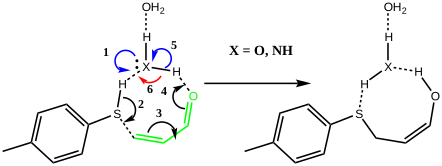
Monday, April 13th, 2020A reaction can be thought of as molecular dancers performing moves. A choreographer is needed to organise the performance into the ballet that is a reaction mechanism. Here I explore another facet of the Michael addition of a nucleophile to a conjugated carbonyl compound. The performers this time are p-toluene thiol playing the role of nucleophile, adding to but-2-enal (green) acting as the electrophile and with either water or ammonia serving the role of a catalytic base to help things along.†
Molecules of the year 2019: Hexagonal planar crystal structures.
Thursday, January 23rd, 2020Here is another selection from the Molecules-of-the-Year shortlist published by C&E News, in which hexagonal planar transition metal coordination is identified. This was a mode of metal coordination first mooted more than 100 years ago,[1] but with the first examples only being discovered recently. The C&E News example comprises a central palladium atom surrounded by three hydride and three magnesium atoms, all seven atoms being in the same plane.
References
- M. Garçon, C. Bakewell, G.A. Sackman, A.J.P. White, R.I. Cooper, A.J. Edwards, and M.R. Crimmin, "A hexagonal planar transition-metal complex", Nature, vol. 574, pp. 390-393, 2019. https://doi.org/10.1038/s41586-019-1616-2
Can a carbon radical act as a hydrogen bond acceptor?
Saturday, December 28th, 2019Having shown that carbon as a carbene centre, C: can act as a hydrogen bond acceptor, as seen from a search of crystal structures, I began to wonder if there is any chance that carbon as a radical centre, C• could do so as well. Definitely a subversive thought, since radical centres are supposed to abstract hydrogens rather than to hydrogen bond to them.
CH…O hydrogen bonding competing with layered dispersion attractions.
Friday, July 19th, 2019I have previously looked at the topic of hydrogen bonding interactions from the hydrogen of chloroform Here I generalize C-H…O interactions by conducting searches of the CSD (Cambridge structure database) as a function of the carbon hybridisation. I am going to jump straight to a specific molecule XEVJIR (DOI: 10.5517/cc5fgpq) identified from the searches appended to this post as interesting for further inspection.[1]
References
- K.S. Huang, M.J. Haddadin, M.M. Olmstead, and M.J. Kurth, "Synthesis and Reactions of Some Heterocyclic Azacyanines<sup>1</sup>", The Journal of Organic Chemistry, vol. 66, pp. 1310-1315, 2001. https://doi.org/10.1021/jo001484k
The shortest known CF…HO hydrogen bond.
Sunday, March 24th, 2019There is a predilection amongst chemists for collecting records; one common theme is the length of particular bonds, either the shortest or the longest. A particularly baffling type of bond is that between the very electronegative F atom and an acid hydrogen atom such as that in OH. Thus short C-N…HO hydrogen bonds are extremely common, as are C-O…HO.‡ But F atoms in C-F bonds are largely thought to be inert to hydrogen bonding, as indicated by the use of fluorine in many pharmaceuticals as inert isosteres.[1] Here I do an up-to-date search of the CSD crystal structure database, which is now on the verge of accumulating 1 million entries, to see if any strong C-F…HO hydrogen bonding may have been recently discovered.
References
- S. Purser, P.R. Moore, S. Swallow, and V. Gouverneur, "Fluorine in medicinal chemistry", Chem. Soc. Rev., vol. 37, pp. 320-330, 2008. https://doi.org/10.1039/b610213c
Elongating an N-B single bond is much easier than stretching a C-C single bond.
Tuesday, October 24th, 2017An N-B single bond is iso-electronic to a C-C single bond, as per below. So here is a simple question: what form does the distribution of the lengths of these two bonds take, as obtained from crystal structures?