Archive for the ‘reaction mechanism’ Category
Saturday, March 8th, 2014
The diazo-coupling reaction dates back to the 1850s (and a close association with Imperial College via the first professor of chemistry there, August von Hofmann) and its mechanism was much studied in the heyday of physical organic chemistry.[1] Nick Greeves, purveyor of the excellent ChemTube3D site, contacted me about the transition state (I have commented previously on this aspect of aromatic electrophilic substitution). ChemTube3D recruits undergraduates to add new entries; Blue Jenkins is one such adding a section on dyes.
(more…)
References
- S.B. Hanna, C. Jermini, H. Loewenschuss, and H. Zollinger, "Indices of transition state symmetry in proton-transfer reactions. Kinetic isotope effects and Bronested's .beta. in base-catalyzed diazo-coupling reactions", Journal of the American Chemical Society, vol. 96, pp. 7222-7228, 1974. https://doi.org/10.1021/ja00830a009
Tags:covalent systems, first professor, free energy, Imperial College, lowest energy pose, Nick Greeves, professor of chemistry
Posted in reaction mechanism | 2 Comments »
Sunday, March 2nd, 2014
A staple of introductory undergraduate teaching in organic chemistry is Markovnikov’s rule, which states: “the addition of a protic acid HX to an alkene results in the acid hydrogen (H) becoming attached to the carbon with fewer alkyl substituents and the halide (X) group to the carbon with more alkyl substituents“. Shortly thereafter, students are exposed to the “anti-Markovnikov” addition of borane to e.g. 2-methylpropene. In order to achieve a consistent explanation for both reactions, I normally show students the following mechanism. Here I introduce a “reality check” to the first component of that mechanism (for the oxidative step, see this post).
(more…)
Posted in reaction mechanism | 6 Comments »
Sunday, February 16th, 2014
The potential energy surface for a molecule tells us about how it might react. These surfaces have been charted for thousands of reactions using quantum mechanics, and their basic features are thought to be well understood. Coming across an entirely new feature is rare. So what do you make of the following?
(more…)
Tags:potential energy surface
Posted in pericyclic, reaction mechanism | 11 Comments »
Thursday, January 2nd, 2014
As my previous post hints, I am performing my annual spring-clean of lecture notes on pericyclic reactions. Such reactions, and their stereochemistry, are described by a set of selection rules. I am always on the lookout for a simple example which can most concisely summarise these rules. The (hypothetical) one shown below I think nicely achieves this, and raises some interesting issues in the process.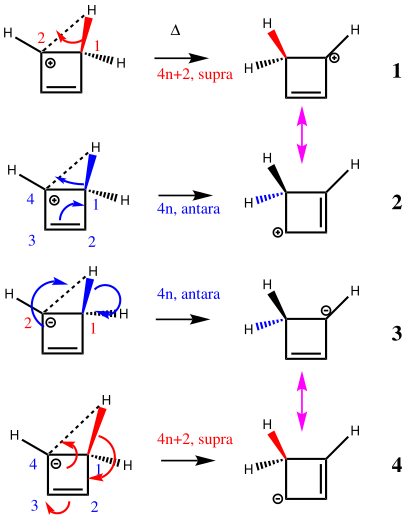
(more…)
Posted in pericyclic, reaction mechanism | No Comments »
Wednesday, December 4th, 2013
I have several times used arrow pushing on these blogs. But since the rules for this convention appear to be largely informal, and there appears to be no definitive statement of them, I thought I would try to produce this for our students. This effort is here shared on my blog. It is what I refer to as the standard version; an advanced version is in preparation. Such formality might come as a surprise to some; arrow-pushing is often regarded as far too approximate to succumb to any definition, although it is of course often examined.
(more…)
Posted in Curly arrows, General, reaction mechanism | 6 Comments »
Wednesday, November 13th, 2013
Not long ago, I described a cyclic carbene in which elevating the carbene lone pair into a π-system transformed it from a formally 4n-antiaromatic π-cycle into a 4n+2 aromatic π-cycle. From an entirely different area of chemistry, another example of this behaviour emerges; Schreiner’s[1] trapping and reactions of t-butyl-hydroxycarbene, as described on Steve Bachrach’s blog. A point I often make is that chemistry is all about connections, and so here I will discuss such a connection.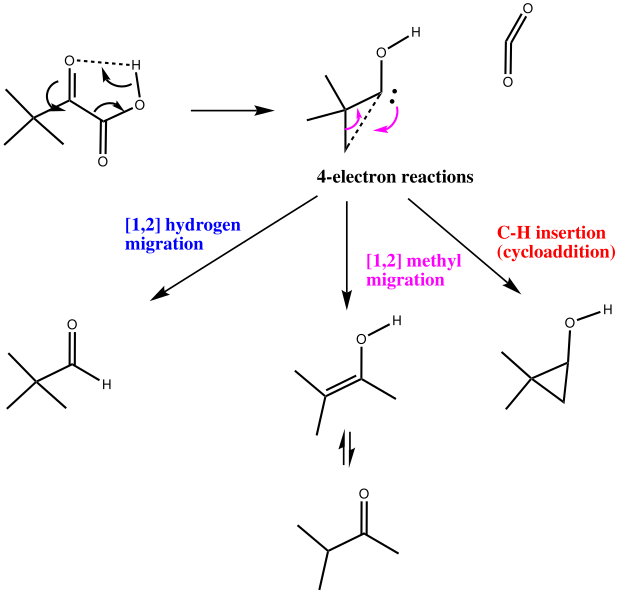
(more…)
References
- D. Ley, D. Gerbig, and P.R. Schreiner, "Tunneling control of chemical reactions: C–H insertion versus H-tunneling in tert-butylhydroxycarbene", Chem. Sci., vol. 4, pp. 677-684, 2013. https://doi.org/10.1039/c2sc21555a
Tags:Steve Bachrach
Posted in pericyclic, reaction mechanism | No Comments »
Tuesday, November 5th, 2013
The concept of kinetic vs thermodynamic control of a reaction is often taught in the context of the enolisation of e.g. 1-methylcyclohexanone as induced by a base. The story goes that at low temperatures (-78°C), the rate of the sterically more hindered thermodynamic enolisation does not compete with the faster kinetic product but that at higher temperatures when an equilibrium is possible, the thermodynamically more stable tetrasubstituted enol is formed. I set out to see if this result can be modelled.
(more…)
Tags:faster kinetic product
Posted in reaction mechanism | 2 Comments »
Saturday, September 21st, 2013
The best known example of the gauche effect is 1,2-difluoroethane, which exhibits a relatively small preference of ~0.5 kcal/mol for this conformer over the anti orientation, which is also a minimum. But FSSF, which I discussed in the previous post, beats this hands down! It also, by the way, must surely be the smallest molecule (only four atoms) which could be theoretically resolved into two enantiomers (possibly at say 273K?).‡
(more…)
Tags:ELF, Transition state
Posted in Interesting chemistry, reaction mechanism | 2 Comments »
Thursday, September 12th, 2013
Andy Extance at the Chemistry World blog has picked up on a fascinating article[1] on the dimer of SF2. This molecule has three F atoms on one S, and only one on the other; FSSF3. But all four S-F bonds are of different length. Lindquist and Dunning claim that the minimum energy pathway to dissociation to two SF2 molecules does not involve breaking either the longest or the weakest SF bond. This was too much for me to resist investigating further!
(more…)
References
- B.A. Lindquist, and T.H. Dunning, "Bonding in FSSF<sub>3</sub>: Breakdown in Bond Length-Strength Correlations and Implications for SF<sub>2</sub> Dimerization", The Journal of Physical Chemistry Letters, vol. 4, pp. 3139-3143, 2013. https://doi.org/10.1021/jz401578h
Tags:Andy Extance, minimum energy pathway
Posted in Interesting chemistry, reaction mechanism | 6 Comments »