Archive for the ‘reaction mechanism’ Category
Wednesday, October 9th, 2019
If, as a synthetic chemist, you want to invert the configuration of an alcohol in which the OH group is at a chiral centre, then the Mitsunobu reaction has been a stalwart for many years. Now a catalytic version has been published, [1] along with a proposed mechanism. Here I apply computation as a reality check to see what the energetics of this mechanism might be.
(more…)
References
- R.H. Beddoe, K.G. Andrews, V. Magné, J.D. Cuthbertson, J. Saska, A.L. Shannon-Little, S.E. Shanahan, H.F. Sneddon, and R.M. Denton, "Redox-neutral organocatalytic Mitsunobu reactions", Science, vol. 365, pp. 910-914, 2019. https://doi.org/10.1126/science.aax3353
Posted in reaction mechanism | No Comments »
Thursday, May 2nd, 2019
Ken Houk’s group has recently published this study of cycloaddition reactions, using a combination of classical transition state location followed by molecular dynamics trajectory calculations,[1] and to which Steve Bachrach’s blog alerted me. The reaction struck me as being quite polar (with cyano groups) and so I took a look at the article to see what both the original[2] experimental conditions were and how the new simulations compared. The reaction itself is shown below.
(more…)
References
- X. Xue, C.S. Jamieson, M. Garcia-Borràs, X. Dong, Z. Yang, and K.N. Houk, "Ambimodal Trispericyclic Transition State and Dynamic Control of Periselectivity", Journal of the American Chemical Society, vol. 141, pp. 1217-1221, 2019. https://doi.org/10.1021/jacs.8b12674
- C.Y. Liu, and S.T. Ding, "Cycloadditions of electron-deficient 8,8-disubstituted heptafulvenes to electron-rich 6,6-disubstituted fulvenes", The Journal of Organic Chemistry, vol. 57, pp. 4539-4544, 1992. https://doi.org/10.1021/jo00042a039
Tags:Chemistry, computational chemistry, Implicit solvation, Ken Houk, Molecular dynamics, Molecular modelling, Natural sciences, Physical sciences, Solutions, Solvent, Solvent model, Solvents, Steve Bachrach, Theoretical chemistry
Posted in reaction mechanism | 2 Comments »
Thursday, April 4th, 2019
Previously, I explored the Graham reaction to form a diazirine. The second phase of the reaction involved an Sn2′ displacement of N-Cl forming C-Cl. Here I ask how facile the simpler displacement of C-Cl by another chlorine might be and whether the mechanism is Sn2 or the alternative Sn1.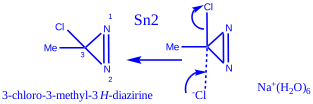 The reason for posing this question is that as an Sn1 reaction, simply ionizing off the chlorine to form a diazacyclopropenium cation might be a very easy process. Why? Because the resulting cation is analogous to the cyclopropenium cation, famously proposed by Breslow as the first example of a 4n+2 aromatic ring for which the value of n is zero and not 1 as for benzene.[1] Another example of a famous “Sn1” reaction is the solvolysis of t-butyl chloride to form the very stable tertiary carbocation and chloride anion (except in fact that it is not an Sn1 reaction but an Sn2 one!)
(more…)
References
- R. Breslow, "SYNTHESIS OF THE s-TRIPHENYLCYCLOPROPENYL CATION", Journal of the American Chemical Society, vol. 79, pp. 5318-5318, 1957. https://doi.org/10.1021/ja01576a067
Tags:animation, Carbenium ion, Cations, Chemical elements, chemical reaction, Chemistry, Chlorine, computational chemistry, Cyclopropenium ion, Diazirine, energy, energy profile, free energy, Halogens, Natural sciences, Nucleophilic aromatic substitution, Oxidizing agents, Physical sciences, potential energy surface, SN1 reaction, Substitution reactions
Posted in reaction mechanism | No Comments »
Sunday, January 13th, 2019
Linear free energy relationships (LFER) are associated with the dawn of physical organic chemistry in the late 1930s and its objectives in understanding chemical reactivity as measured by reaction rates and equilibria.
(more…)
Tags:Benzoic acid, Chemical kinetics, chemical reaction, chemical reactivity, chemist, Chemistry, Electrophilic aromatic substitution, energy point, Equations, Equilibrium chemistry, Equilibrium constant, free energy overall route, Hammett equation, Linear free energy relationships, Natural sciences, Organic chemistry, Physical organic chemistry, Physical sciences, Reactivity
Posted in Chemical IT, Interesting chemistry, reaction mechanism | No Comments »
Sunday, October 1st, 2017
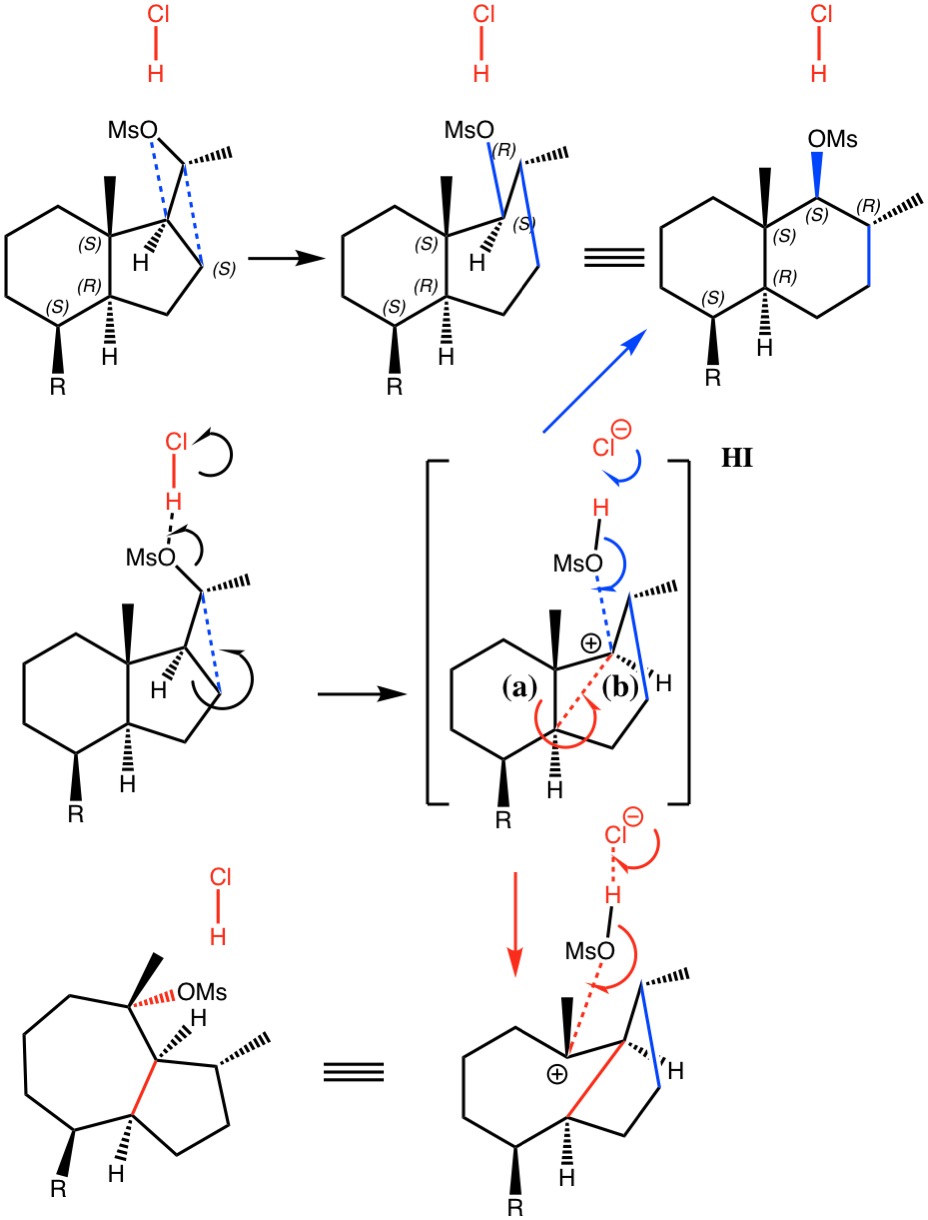
I noted in my WATOC conference report a presentation describing the use of calculated reaction barriers (and derived rate constants) as mechanistic reality checks. Computations, it was claimed, have now reached a level of accuracy whereby a barrier calculated as being 6 kcal/mol too high can start ringing mechanistic alarm bells. So when I came across this article[1] in which calculated barriers for a dyotropic ring expansion observed under mild conditions in dichloromethane as solvent were used to make mechanistic inferences, I decided to explore the mechanism a bit further.
(more…)
References
- H. Santalla, O.N. Faza, G. Gómez, Y. Fall, and C. Silva López, "From Hydrindane to Decalin: A Mild Transformation through a Dyotropic Ring Expansion", Organic Letters, vol. 19, pp. 3648-3651, 2017. https://doi.org/10.1021/acs.orglett.7b01621
Tags:animation, bicyclic ring product, energy derivative gradient norm, energy profile, final non-ionic product, Organic chemistry, possible products, potential energy surface, realistic model for the reaction
Posted in pericyclic, reaction mechanism | 3 Comments »
Thursday, September 21st, 2017
A recent article reports, amongst other topics, a computationally modelled reaction involving the capture of molecular hydrogen using a substituted borane (X=N, Y=C).[1] The mechanism involves an initial equilibrium between React and Int1, followed by capture of the hydrogen by Int1 to form a 5-coordinate borane intermediate (Int2 below, as per Figure 11).‡ This was followed by assistance from a proximate basic nitrogen to complete the hydrogen capture via a TS involving H-H cleavage. The forward free energy barrier to capture was ~11 kcal/mol and ~4 kcal/mol in the reverse direction (relative to the species labelled Int1), both suitably low for reversible hydrogen capture. Here I explore a simple variation to this fascinating reaction.∞
(more…)
References
- L. Li, M. Lei, Y. Xie, H.F. Schaefer, B. Chen, and R. Hoffmann, "Stabilizing a different cyclooctatetraene stereoisomer", Proceedings of the National Academy of Sciences, vol. 114, pp. 9803-9808, 2017. https://doi.org/10.1073/pnas.1709586114
Tags:Ammonia borane, animation, Boranes, Chemistry, Cleaning Services, Company: React Group, free energy barrier, Hydroboration, Hydrogen, Matter
Posted in reaction mechanism | 1 Comment »
Thursday, April 6th, 2017
Enols are simple compounds with an OH group as a substituent on a C=C double bond and with a very distinct conformational preference for the OH group. Here I take a look at this preference as revealed by crystal structures, with the theoretical explanation.
(more…)
Tags:Chemical bond, chemical bonding, Chemistry, Conformational isomerism, constrained search, Enol, free energy, Gauche effect, Hydrogen bond, Isomerism, Java, Physical organic chemistry, search query, Stereochemistry, Supramolecular chemistry
Posted in crystal_structure_mining, reaction mechanism | 2 Comments »
Saturday, April 1st, 2017
In a comment appended to an earlier post, I mused about the magnitude of the force constant relating to the interconversion between a classical and a non-classical structure for the norbornyl cation. Most calculations indicate the force constant for an “isolated” symmetrical cation is +ve, which means it is a true minimum and not a transition state for a [1,2] shift. The latter would have been required if the species equilibrated between two classical carbocations. I then pondered what might happen to both the magnitude and the sign of this force constant if various layers of solvation and eventually a counter-ion were to be applied to the molecule, so that a bridge of sorts between the different states of solid crystals, superacid and aqueous solutions might be built.
(more…)
Tags:Carbocations, chemical bonding, Chemistry, constant matrix/search direction, continuum model for water, gas phase, Paul Schleyer, Physical organic chemistry, potential energy surface, Reactive intermediates, superacid and aqueous solutions
Posted in crystal_structure_mining, Interesting chemistry, reaction mechanism | 7 Comments »
Monday, March 20th, 2017
The example a few posts back of how methane might invert its configuration by transposing two hydrogen atoms illustrated the reaction mechanism by locating a transition state and following it down in energy using an intrinsic reaction coordinate (IRC). Here I explore an alternative method based instead on computing a molecular dynamics trajectory (MD).
(more…)
Tags:animation, chemical reaction, Chemistry, computational chemistry, computed potential energy surface, energy, Gaseous signaling molecules, Hydrogen, kinetic energy, kinetic energy contributions, Methane, Molecular dynamics, Physical chemistry, Quantum chemistry, Reaction coordinate, simulation, Theoretical chemistry
Posted in reaction mechanism | 2 Comments »
Sunday, March 19th, 2017
A pyrophoric metal is one that burns spontaneously in oxygen; I came across this phenomenon as a teenager doing experiments at home. Pyrophoric iron for example is prepared by heating anhydrous iron (II) oxalate in a sealed test tube (i.e. to 600° or higher). When the tube is broken open and the contents released, a shower of sparks forms. Not all metals do this; early group metals such as calcium undergo a different reaction releasing carbon monoxide and forming calcium carbonate and not the metal itself. Here as a prelude to the pyrophoric reaction proper, I take a look at this alternative mechanism using calculations.
(more…)
Tags:Aluminium, calculated free energy barrier, Carbon monoxide, Chemical elements, Chemistry, higher activation energy, Iron, Matter, metal, metal oxalates, Oxide, pyrophoric metal, Pyrophoricity, Reducing agents
Posted in crystal_structure_mining, reaction mechanism | 1 Comment »