Author Archive
Thursday, December 15th, 2022
In the previous post, I discussed how data associated with two of the candidates for molecules of the year – 2022 could be retrieved and then used to inspect their three dimensional structures. Here I focus on the ultra large cavitands recently reported[1]. As I noted, these have an associated data coordinate archive published on Zenodo (DOI: 10.5281/zenodo.6953961) although this is not cited in the article itself.
(more…)
References
- J. Pfeuffer‐Rooschüz, S. Heim, A. Prescimone, and K. Tiefenbacher, "Megalo‐Cavitands: Synthesis of Acridane[4]arenes and Formation of Large, Deep Cavitands for Selective C70 Uptake", Angewandte Chemie International Edition, vol. 61, 2022. https://doi.org/10.1002/anie.202209885
Posted in Uncategorised | No Comments »
Tuesday, December 13th, 2022
The list of molecules of the year is out now at C&E News (but you have to have an account to view the list, unlike previous years).♣ These three caught my eye:
(more…)
Posted in Uncategorised | No Comments »
Tuesday, November 29th, 2022
The topic of dicarbon, C2, has been discussed here for a few years now. It undoubtedly would be a gas! This aspect of the species came to the fore recently[1] when further experiments on a potential chemical precursor of dicarbon, the zwitterion X(+)-C≡C(-), showed that different variants of X(+), such as not only X=PhI(+), but also e.g. X=dibenzothiophenium(+) appeared to generate a gaseous species, which could be trapped as “C2” in a solvent-free connected flask experiment.
(more…)
References
- H.S. Rzepa, M. Arita, K. Miyamoto, and M. Uchiyama, "A combined DFT-predictive and experimental exploration of the sensitivity towards nucleofuge variation in zwitterionic intermediates relating to mechanistic models for unimolecular chemical generation and trapping of free C
<sub>2</sub>
and alternative bimolecular pathways involving no free C
<sub>2</sub>", Physical Chemistry Chemical Physics, vol. 24, pp. 25816-25821, 2022. https://doi.org/10.1039/d2cp01214f
Posted in reaction mechanism | No Comments »
Friday, October 21st, 2022
What’s a Journal For? This debate has been raging ever since preprint servers were introduced as far back as 1991! Indeed, during my recent submission of a journal article, one of the questions asked was whether the article was already deposited in such a preprint server (in a positive sense, and not one excluding further submission progress). Since my previous comment on this theme was made more than three years ago, I thought I might update it.
(more…)
Tags:Interesting chemistry
Posted in Uncategorised | No Comments »
Saturday, October 8th, 2022
Sometimes you come across a reaction which is so simple in concept that you wonder why it took so long to be accomplished in practice. In this case, replacing toxic ozone O3 as used to fragment an alkene into two carbonyl compounds (“ozonolysis”) by a relatively non-toxic simple nitro-group based reagent, ArNO2 in which the central atom of ozone is substituted by an N-aryl group. As reported by Derek Lowe, two groups have published[1], [2] details of such a reaction (Ar = 4-cyano or 3-CF3,5-NO2). But there are (at least) two tricks; the first is to use photo-excitation using purple LEDs (390nm light) to activate the nitro group. The second is to establish the best aryl substituents to use for achieving maximum yields of the carbonyl compounds and the best conditions for achieving the cyclo-reversion reaction, shown below as TS1. That step requires heating the cyclo-adduct up to ~80° in (aqueous) acetonitrile for anywhere between 1-48 hours. Here I take a computational look at that last step, the premise being that if such a model is available for this mechanism, it could in principle be used to optimise the conditions for the process.
(more…)
References
- D.E. Wise, E.S. Gogarnoiu, A.D. Duke, J.M. Paolillo, T.L. Vacala, W.A. Hussain, and M. Parasram, "Photoinduced Oxygen Transfer Using Nitroarenes for the Anaerobic Cleavage of Alkenes", Journal of the American Chemical Society, vol. 144, pp. 15437-15442, 2022. https://doi.org/10.1021/jacs.2c05648
- A. Ruffoni, C. Hampton, M. Simonetti, and D. Leonori, "Photoexcited nitroarenes for the oxidative cleavage of alkenes", Nature, vol. 610, pp. 81-86, 2022. https://doi.org/10.1038/s41586-022-05211-0
Tags:Interesting chemistry
Posted in reaction mechanism | No Comments »
Friday, September 30th, 2022
The term bispericyclic reaction was famously coined by Caramella et al in 2002[1] to describe the unusual features of the apparently innocuous dimerisation of cyclopentadiene. It shows features of two paths for different pericyclic reactions, comprising a 2+4 cycloaddition in the early stages, but evolving into a (degenerate) pair of [3,3] sigmatropic reactions in the latter stages. Houk (who also uses the term ambimodal) has in recent years extended the number of examples of such pericyclic sequences to trispericyclic[2] (see here) and even an ambimodel tetrapericyclic reaction, as reported at the recent WATOC event. Here I show an example of a new type of bispericyclic reaction, comprising a 2+4 cycloaddition combined with a electrocyclic ring opening.
(more…)
References
- P. Caramella, P. Quadrelli, and L. Toma, "An Unexpected Bispericyclic Transition Structure Leading to 4+2 and 2+4 Cycloadducts in the <i>E</i><i>ndo</i> Dimerization of Cyclopentadiene", Journal of the American Chemical Society, vol. 124, pp. 1130-1131, 2002. https://doi.org/10.1021/ja016622h
- X. Xue, C.S. Jamieson, M. Garcia-Borràs, X. Dong, Z. Yang, and K.N. Houk, "Ambimodal Trispericyclic Transition State and Dynamic Control of Periselectivity", Journal of the American Chemical Society, vol. 141, pp. 1217-1221, 2019. https://doi.org/10.1021/jacs.8b12674
Posted in reaction mechanism | No Comments »
Thursday, September 15th, 2022
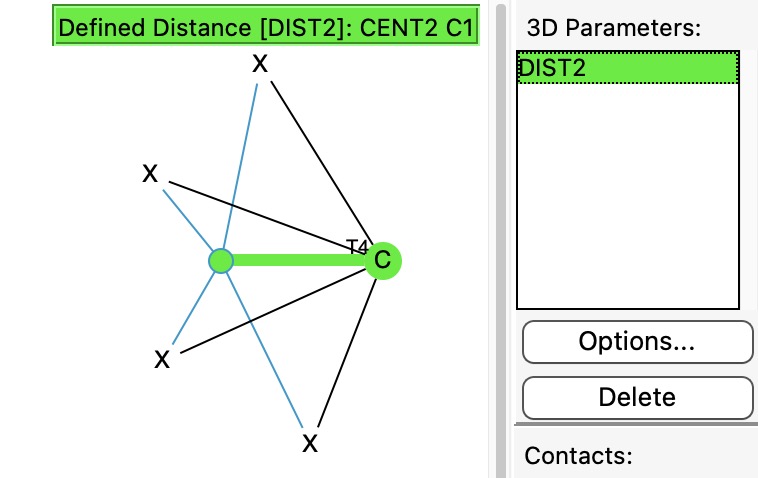
In previously asking what the largest angle subtended at four-coordinate carbon might be, I noted that as the angle increases beyond 180°, the carbon becomes inverted, or hemispherical (all four ligands in one hemisphere). So what does a search for this situation reveal in the CSD? The query can be formulated as below, in which the distance from the centroid of the four ligands to the central carbon is specified to be in e.g. the range 0.8 to 1.1Å. For tetrahedral carbon surrounded by four carbon ligands, the value would be close to zero, so any value larger than say 0.8Å is worth inspecting.
(more…)
Posted in Uncategorised | 2 Comments »
Sunday, September 11th, 2022
Four-coordinate carbon normally adopts a tetrahedral shape, where the four angles at the carbon are all 109.47°. But how large can that angle get, and can it even get to be 180°?
(more…)
Tags:Interesting chemistry
Posted in Uncategorised | 1 Comment »
Thursday, September 8th, 2022
The recently reported synthesis[1] of octafluorocubane established a sublimation point as 168.1–177.1°C (a melting point was not observed). In contrast, the heavier perfluoro-octane has an m.p. of -25°C. Why the difference? Firstly, the crystal structure is shown below, albeit as a dimer rather than a periodic lattice (click on image to obtain 3D coordinates).
(more…)
References
- M. Sugiyama, M. Akiyama, Y. Yonezawa, K. Komaguchi, M. Higashi, K. Nozaki, and T. Okazoe, "Electron in a cube: Synthesis and characterization of perfluorocubane as an electron acceptor", Science, vol. 377, pp. 756-759, 2022. https://doi.org/10.1126/science.abq0516
Posted in Uncategorised | 2 Comments »
Monday, August 29th, 2022
Derek Lowe reports the story[1] that the recently synthesized octafluorocubane can absorb one electron to form a radical anion – an electron in a cube. So I thought it would be fun to compute exactly where that electron sits!
(more…)
References
- M. Sugiyama, M. Akiyama, Y. Yonezawa, K. Komaguchi, M. Higashi, K. Nozaki, and T. Okazoe, "Electron in a cube: Synthesis and characterization of perfluorocubane as an electron acceptor", Science, vol. 377, pp. 756-759, 2022. https://doi.org/10.1126/science.abq0516
Posted in Uncategorised | 10 Comments »