I posed[1] this question back in 2010: “(Almost) 100 years of Lewis[2] structures: are they still fit for purpose?”. I was reminded of this when I came across this relatively recent article[3] describing the structures of three binary sulfur-nitrogen anions, as shown in Figure 1 of their article. These are reproduced below (Scheme 1) along with an additional S/N molecule reported separately.[4]
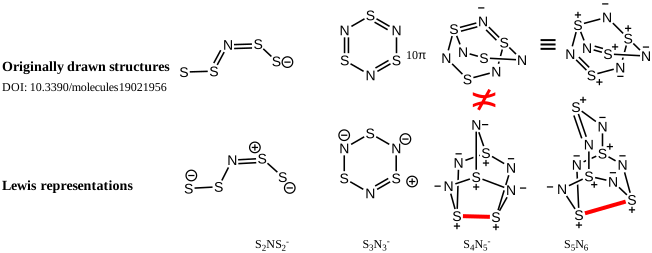 Scheme 1. Molecular structure representations of sulfur nitrides.
Lewis structures are of course widely exploited in organic chemistry, but apparently less so in inorganic chemistry. Not only are there simple heuristic rules for deriving them, these can be checked using pretty rigorous quantum mechanical procedures, using a method known as NBO7.[5] Thus the NBO7 derived Lewis structures are placed below the literature representations in scheme 1.[6],[7],[8],[9] Each of the structures has interesting features which a Lewis structure can help tease out.
S4N–
The S=N=S representational motif is often used in sulfur-nitrogen chemistry, but in organic molecules four-valent nitrogen occurs only as a positively charged cation, and equally sulfur atoms with three substituents (or one double and one single bond) are represented as positively charged cations, whilst sulfur atoms with just one bond are always negatively charged sulfur anions. So none of the four atoms in this literature structure correspond to a Lewis-style representation. The NBO7-derived diagram fully conforms to the “organic” rules, and now contains three charged S atoms.
S3N3–
This is of interest since it is regarded as an “aromatic molecule” conforming to the 4n+2 rule for aromaticity. But the literature diagram implies n=1 (six cyclically conjugated π-electrons). In fact for the NBO7 derived representation, n=2 making ten π-electrons or a difference of four electrons! I should mention here that NBO7 orbitals are not “symmetry adapted”, ie they need not reflect molecular symmetry – this being another difference between the literature and the NBO7 representations.
S4N5–
The literature representation contains one negatively charged atom, the tetravalent nitrogen. In fact such a structure is highly improbable, since the valence shell of the nitrogen would have to exceed 8 electrons. Two of the S atoms are depicted as trivalent neutral and three nitrogens are divalent neutral – all non-conformant with organic Lewis structures. With the NBO7 representation, all the atoms are charged, four +ve S and five -ve N. But there is a far more significant difference, the NBO7 version has an additional S-S bond (red in scheme). Without this, any attempt at Lewis representation must result in four +ve S and three -ve N and hence the wrong overall charge on the system (S4N5+).
S5N6
This neutral molecule was reported[4] without any attempt at a Lewis representation, which is shown here with five +ve S and five -ve N atoms and again having an S-S bond (Figure 1) with the same motif as for S4N5–.
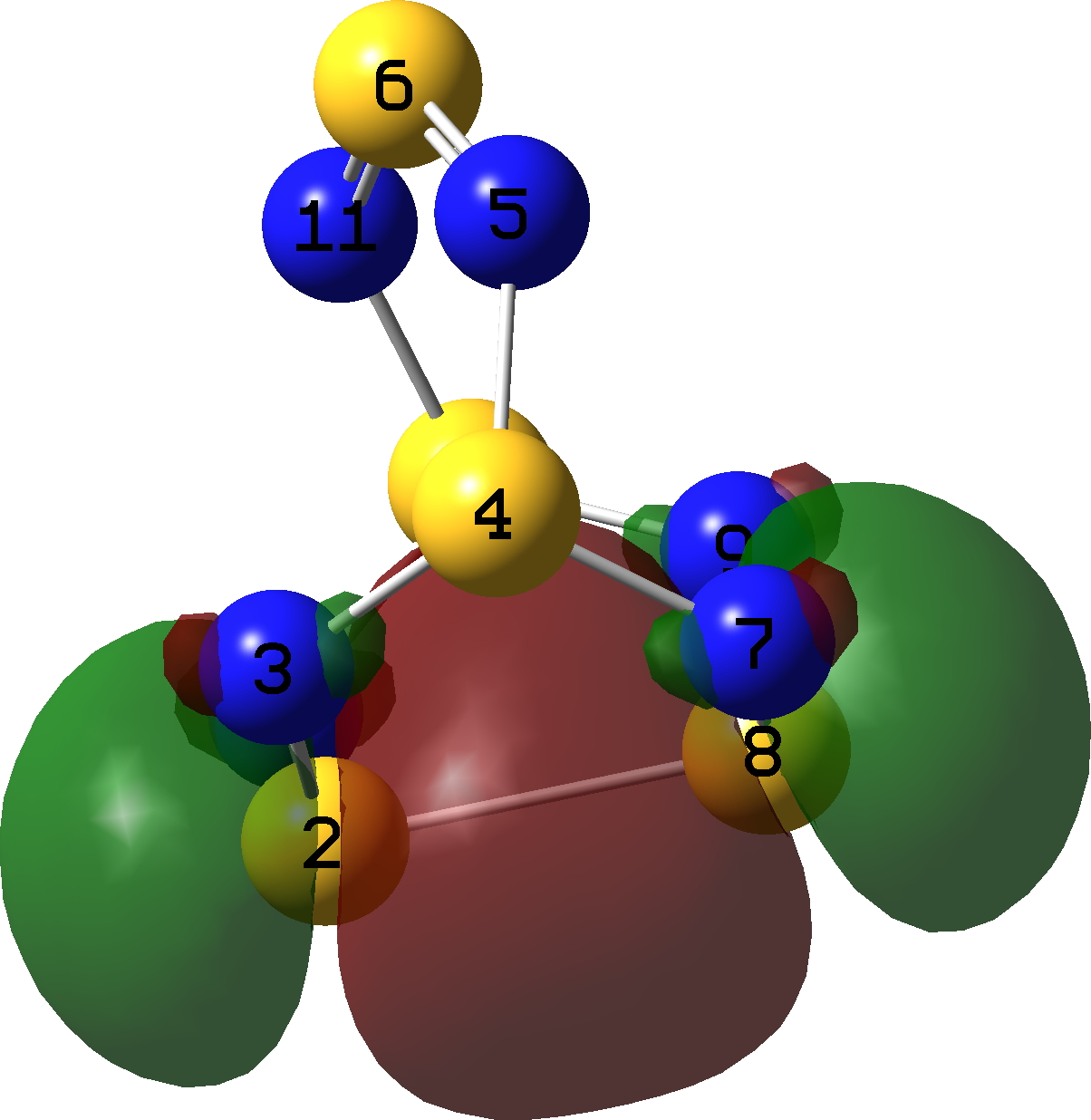
Figure 1. The S-S bond in S5N6 (red).
Conclusions
Lewis representations for the four sulfur nitrides shown here are easily validated using NBO7 calculations. In the example of S3N3–, this representation is useful in helping to correctly identify the number of π-electrons to be used in any aromaticity rule. With S4N5– the Lewis representation requires a two-electron S-S bond to be present (hence the difference of two electrons between S4N5+ and S4N5–) and the neutral S5N6 has a similar S-S bond.
Author

References
- H. Rzepa, "(Almost) 100 years of Lewis structures: are they still fit for purpose?", 2010. https://doi.org/10.59350/rncje-xe063
- G.N. Lewis, "THE ATOM AND THE MOLECULE.", Journal of the American Chemical Society, vol. 38, pp. 762-785, 1916. https://doi.org/10.1021/ja02261a002
- R. Boeré, T. Roemmele, and M. Krall, "A Variable Temperature X-ray Diffraction Investigation of [PPN+][S4N5−]: Supramolecular Interactions Governing an Order/Disorder Transformation and the First High Resolution X-ray Structure of the Anion", Molecules, vol. 19, pp. 1956-1975, 2014. https://doi.org/10.3390/molecules19021956
- T. Chivers, and J. Proctor, "Preparation and crystal structure of a new sulphur nitride, S5N6; a molecular basket", Journal of the Chemical Society, Chemical Communications, pp. 642, 1978. https://doi.org/10.1039/c39780000642
- E.D. Glendening, C.R. Landis, and F. Weinhold, "<i>NBO 7.0</i> : New vistas in localized and delocalized chemical bonding theory", Journal of Computational Chemistry, vol. 40, pp. 2234-2241, 2019. https://doi.org/10.1002/jcc.25873
- H. Rzepa, "SSNSS", 2026. https://doi.org/10.5281/zenodo.23118031
- H. Rzepa, "S3N3 (-) NBO7", 2026. https://doi.org/10.5281/zenodo.23086044
- H. Rzepa, "Tetrasulfur pentanitride anion, MN15L/Def2-TZVPP NBO7", 2026. https://doi.org/10.5281/zenodo.23120288
- H. Rzepa, "S5N6 MN15L/Def2-TZVPP, C2 symmetry NBO7", 2026. https://doi.org/10.5281/zenodo.23118480
What would you say, in the current accepted usage, is the difference between delocalised and (anti-)aromatic structures?