December 6th, 2013
Text books will announce that during aromatic electrophilic substitution, aromaticity is lost by the formation of a Wheland intermediate (and regained by eliminating a proton). Is that entirely true?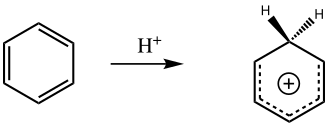
Read the rest of this entry »
Tags: actual energy
Posted in Interesting chemistry | 25 Comments »
December 4th, 2013
I have several times used arrow pushing on these blogs. But since the rules for this convention appear to be largely informal, and there appears to be no definitive statement of them, I thought I would try to produce this for our students. This effort is here shared on my blog. It is what I refer to as the standard version; an advanced version is in preparation. Such formality might come as a surprise to some; arrow-pushing is often regarded as far too approximate to succumb to any definition, although it is of course often examined.
Read the rest of this entry »
Posted in Curly arrows, General, reaction mechanism | 6 Comments »
December 2nd, 2013
This is one of those topics that seems to crop up every three years or so. Since then, new versions of operating systems, new versions of programs, mobile devices and perhaps some progress?
Read the rest of this entry »
Tags: chemical data, chemical semantics, chemical structure diagrams, chemical structures, desktop operating systems, mature technology, mobile devices, much current software, operating system, operating systems, veritable word processor, Word, word processor, XML
Posted in Chemical IT | No Comments »
November 23rd, 2013
Mercury (IV) tetrafluoride attracted much interest when it was reported in 2007[1] as the first instance of the metal being induced to act as a proper transition element (utilising d-electrons for bonding) rather than a post-transition main group metal (utilising just s-electrons) for which the HgF2 dihalide would be more normal (“Is mercury now a transition element?”[2]). Perhaps this is the modern equivalent of transmutation! Well, now we have new speculation about how to induce the same sort of behaviour for caesium; might it form CsF3 (at high pressures) rather than the CsF we would be more familiar with.[3] Here I report some further calculations inspired by this report.
Read the rest of this entry »
References
- X. Wang, L. Andrews, S. Riedel, and M. Kaupp, "Mercury Is a Transition Metal: The First Experimental Evidence for HgF<sub>4</sub>", Angewandte Chemie International Edition, vol. 46, pp. 8371-8375, 2007. https://doi.org/10.1002/anie.200703710
- M. Miao, "Caesium in high oxidation states and as a p-block element", Nature Chemistry, vol. 5, pp. 846-852, 2013. https://doi.org/10.1038/nchem.1754
Tags: animation, energy, free energy barrier, free energy change, metal, pence, post-transition main group metal, potential energy surface
Posted in Hypervalency, Interesting chemistry | 13 Comments »
November 13th, 2013
Not long ago, I described a cyclic carbene in which elevating the carbene lone pair into a π-system transformed it from a formally 4n-antiaromatic π-cycle into a 4n+2 aromatic π-cycle. From an entirely different area of chemistry, another example of this behaviour emerges; Schreiner’s[1] trapping and reactions of t-butyl-hydroxycarbene, as described on Steve Bachrach’s blog. A point I often make is that chemistry is all about connections, and so here I will discuss such a connection.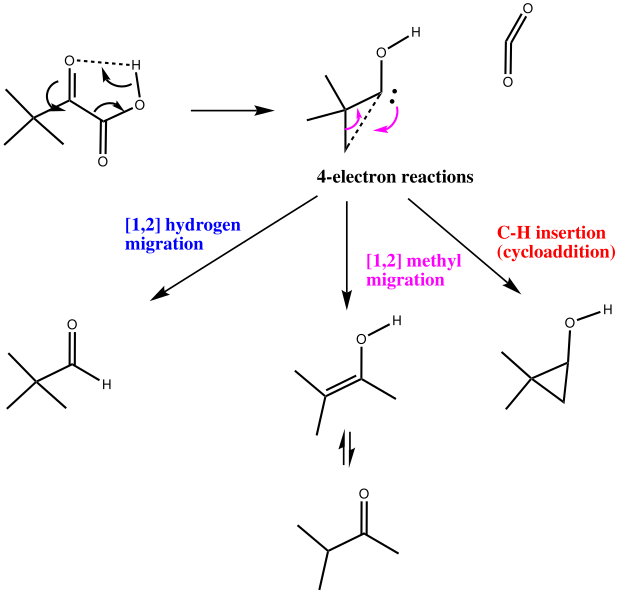
Read the rest of this entry »
References
- D. Ley, D. Gerbig, and P.R. Schreiner, "Tunneling control of chemical reactions: C–H insertion versus H-tunneling in tert-butylhydroxycarbene", Chem. Sci., vol. 4, pp. 677-684, 2013. https://doi.org/10.1039/c2sc21555a
Tags: Steve Bachrach
Posted in pericyclic, reaction mechanism | No Comments »
November 10th, 2013
In the previous post I mentioned in passing the Grignard reagent benzyl magnesium bromide as having tetrahedral coordination at Mg. But I have now noticed, largely through spotting Steve Bachrach’s post on “Acene dimers – open or closed?” another geometric effect perhaps worthy of note, certainly one not always noted in the past; that of dispersion forces.
Read the rest of this entry »
Tags: metal-metal bonding, Steve Bachrach, X-ray
Posted in Interesting chemistry | 1 Comment »
November 5th, 2013
The concept of kinetic vs thermodynamic control of a reaction is often taught in the context of the enolisation of e.g. 1-methylcyclohexanone as induced by a base. The story goes that at low temperatures (-78°C), the rate of the sterically more hindered thermodynamic enolisation does not compete with the faster kinetic product but that at higher temperatures when an equilibrium is possible, the thermodynamically more stable tetrasubstituted enol is formed. I set out to see if this result can be modelled.
Read the rest of this entry »
Tags: faster kinetic product
Posted in reaction mechanism | 2 Comments »
October 31st, 2013
The element silicon best represents the digital era of the mid 20th century to the present; without its crystalline form, there would be no computers (or this blog). Although it was first prepared in pure amorphous (powder) form around 1823[1] by Berzelius, it was not until 1854 that Henri Sainte-Claire Deville made it in crystalline form, using metallic aluminium to isolate it. He described it [1] as having a “metallic luster”.
Read the rest of this entry »
References
Tags: Antoine Balard, artist, Henri Sainte-Claire Deville, Royal Institution in London, University College London
Posted in Interesting chemistry | 1 Comment »
October 26th, 2013
The 1H NMR spectrum of an aromatic molecule such as benzene is iconic; one learns that the unusual chemical shift of the protons (~δ 7-8 ppm) is due to their deshielding by a diatropic ring current resulting from the circulation of six aromatic π-electrons following the Hückel 4n+2 rule. But rather less well-known is the spectacular inversion of these effects as induced by the paratropic circulation of 4n electrons. A 4n+2 rule can be converted to a 4n one by the addition of two electrons, and chemically this can be done by reduction with lithium metal to form a dianion. Fortunately, this experiment has been done for a molecule known as methano[10]annulene. This is a 4n+2 aromatic molecule 1 with ten π-electrons (n=2) that can be reduced with lithium metal to form an ion-pair 2 comprising lithium cations and the twelve π-electron (4n, n=3) methano[10]annulene dianion.[1]
Read the rest of this entry »
References
- D. Schmalz, and H. Günther, "1,6‐Methano[10]annulene Dianion, a Paratropic 12π‐Electron Dianion with a C<sub>10</sub> Perimeter", Angewandte Chemie International Edition in English, vol. 27, pp. 1692-1693, 1988. https://doi.org/10.1002/anie.198816921
Tags: chemical shifts, lithium metal, unusual chemical shift
Posted in Interesting chemistry | No Comments »