November 9th, 2019
The notorious neurotoxin Tetrodotoxin is often chemically represented as a zwitterion, shown below as 1. This idea seems to originate from a famous article written in 1964 by the legendary organic chemist, Robert Burns Woodward.[1] This structure has propagated on to Wikipedia and is found in many other sources. 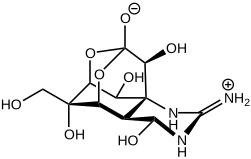
With the elegance and the unique style that is typical Woodward, his article is a tour de force because of the way in which he deploys a large armoury of spectroscopic (X-ray crystal,† NMR, IR) as well as physicochemical (pKa) tools to infer this structure; an approach that has been subsequently widely emulated. The article a well worth a read for the elegant logic that slowly builds to a climax on page 73 (sic!) of the article, when he unveils his final structure (XXXVIII, or 38). The lecture(s) from which the article is apparently derived must have been one hell of an occasion.‡
Read the rest of this entry »
References
- R.B. Woodward, "The structure of tetrodotoxin", Pure and Applied Chemistry, vol. 9, pp. 49-74, 1964. https://doi.org/10.1351/pac196409010049
Posted in Interesting chemistry | 4 Comments »
October 19th, 2019
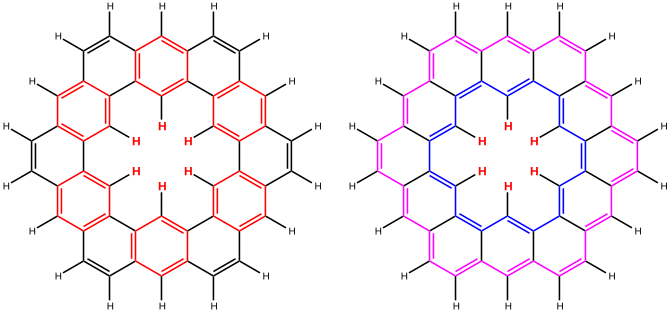
Increasingly, individual small molecules are having their structures imaged using STM, including cyclo[18]carbon that I recently discussed. The latest one receiving such treatment is Kekulene.[1]
Read the rest of this entry »
References
- I. Pozo, Z. Majzik, N. Pavliček, M. Melle-Franco, E. Guitián, D. Peña, L. Gross, and D. Pérez, "Revisiting Kekulene: Synthesis and Single-Molecule Imaging", Journal of the American Chemical Society, vol. 141, pp. 15488-15493, 2019. https://doi.org/10.1021/jacs.9b07926
Posted in Interesting chemistry | 1 Comment »
October 9th, 2019
If, as a synthetic chemist, you want to invert the configuration of an alcohol in which the OH group is at a chiral centre, then the Mitsunobu reaction has been a stalwart for many years. Now a catalytic version has been published, [1] along with a proposed mechanism. Here I apply computation as a reality check to see what the energetics of this mechanism might be.
Read the rest of this entry »
References
- R.H. Beddoe, K.G. Andrews, V. Magné, J.D. Cuthbertson, J. Saska, A.L. Shannon-Little, S.E. Shanahan, H.F. Sneddon, and R.M. Denton, "Redox-neutral organocatalytic Mitsunobu reactions", Science, vol. 365, pp. 910-914, 2019. https://doi.org/10.1126/science.aax3353
Posted in reaction mechanism | No Comments »
October 3rd, 2019
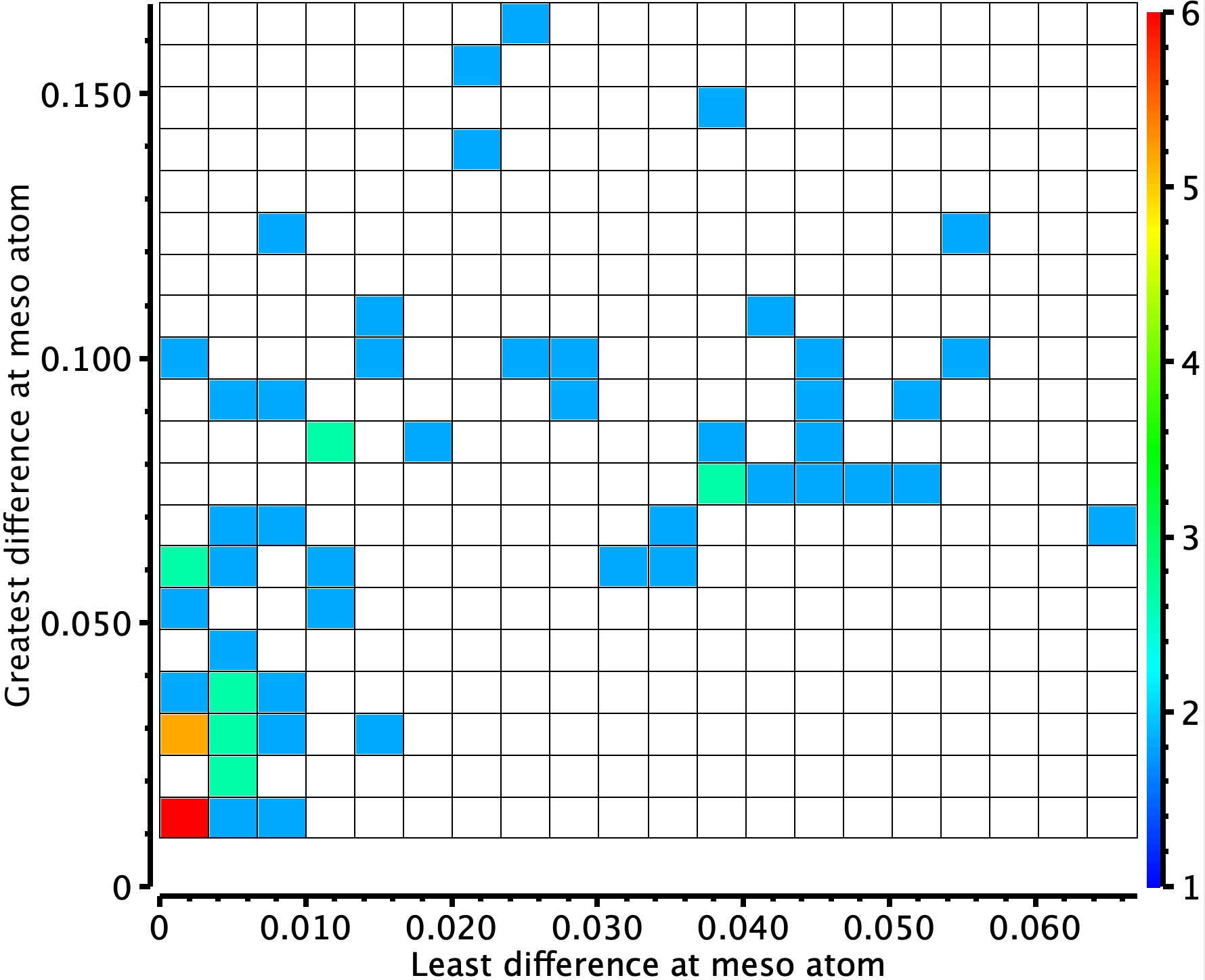
In the previous post, I looked at a class of molecule known as hexaphyrins, inspecting bond length alternation (BLA) at the so-called meso position, the carbon atom joining two pyrrole rings. A search of the difference in bond lengths at this position had shown two significant clusters of crystal structures.
 Molecules in the bottom left of this diagram shows little or no bond length alternation. The right middle shows another cluster with more extreme (and unequal) bond length alternation. I have selected one molecule from this cluster, EGIJEK and it differs from EGIHUY in having four NH units in the ring, whereas the latter has only two.
Read the rest of this entry »
Posted in Interesting chemistry | No Comments »
September 30th, 2019
The theme of the last three posts derives from the recently reported claimed experimental observation of bond length alternation (BLA) in cyclo[18]carbon, a ring of just 18 carbon atoms.[1] Having found that different forms of quantum calculation seem to find this property particularly difficult to agree upon, not only for cyclocarbon but for twisted lemniscular annulenes (which contain CH rather than just C units), I thought it might be time to look at some more experimental data and my chosen system is a class called the hexaphyrins, of which there are a number of experimental crystal structures.
Read the rest of this entry »
References
- K. Kaiser, L.M. Scriven, F. Schulz, P. Gawel, L. Gross, and H.L. Anderson, "An sp-hybridized molecular carbon allotrope, cyclo[18]carbon", Science, vol. 365, pp. 1299-1301, 2019. https://doi.org/10.1126/science.aay1914
Posted in Interesting chemistry | No Comments »
September 27th, 2019
In the previous posts, I tried to track down the onset of bond length alternation (BLA) as a function of ring size in aromatic cyclocarbons, finding the answer varied dramatically depending on the type of method used to calculate it. So here I change the system to an unusual kind of aromatic ring, the leminiscular or figure-eight annulene series.♥ I explore the Kekulé vibration for such species for which a 4n+2 π electron count means they are cyclically Möbius aromatic.[1]
Read the rest of this entry »
References
- P.L. Ayers, R.J. Boyd, P. Bultinck, M. Caffarel, R. Carbó-Dorca, M. Causá, J. Cioslowski, J. Contreras-Garcia, D.L. Cooper, P. Coppens, C. Gatti, S. Grabowsky, P. Lazzeretti, P. Macchi, Ã. Martín Pendás, P.L. Popelier, K. Ruedenberg, H. Rzepa, A. Savin, A. Sax, W.E. Schwarz, S. Shahbazian, B. Silvi, M. Solà, and V. Tsirelson, "Six questions on topology in theoretical chemistry", Computational and Theoretical Chemistry, vol. 1053, pp. 2-16, 2015. https://doi.org/10.1016/j.comptc.2014.09.028
Posted in Interesting chemistry | 2 Comments »
September 3rd, 2019
In the previous post, I looked at the so-called Kekulé vibration of cyclo[18]carbon using various quantum methods and basis sets. Because some of these procedures can take a very long time, I could not compare them using the same high-quality consistent atom basis set for the carbon (Def2-TZVPP). Here I try to start to do this using the smaller six and ten carbon rings to see what trends might emerge. FAIR data are at DOI: 10.14469/hpc/6069
Read the rest of this entry »
Posted in Interesting chemistry | 2 Comments »
August 30th, 2019
I have discussed the vibration in benzene known as the Kekulé mode in other posts, the first of which was all of ten years ago. It is a stretching mode that lengthens three of the bonds in benzene (a [6]-annulene) and shortens the other three, thus leading to a cyclohexatriene motif (see below). This vibration is real (+ve force constant) in benzene itself, which indicates that distorting the structure from six to three-fold symmetry leads to an increase in energy. Benzene therefore has a symmetrising influence, and it comes as a surprise to most to learn that this is actually due to the σ rather than the π-electrons! But there are good reasons to believe that as the ring size of the annulene increases, the Kekulé vibration will evolve from a real mode into an imaginary (-ve force constant) vibration representing a transition state for mutating the single and double bonds. At some point therefore, the more symmetrical geometry of the annulene in which all the bonds are of equal length will change into one of lower symmetry, in which BLA (bond length alternation) occurs and the symmetrical form becomes a transition state for this process.
Read the rest of this entry »
Posted in Interesting chemistry | No Comments »
August 4th, 2019
In the pipeline reports on an intriguing new ring system acting as an isostere for morpholine. I was interested in how the conformation of this ring system might be rationalised electronically and so I delved into the article.[1] Here I recount what I found.
Read the rest of this entry »
References
- H. Hobbs, G. Bravi, I. Campbell, M. Convery, H. Davies, G. Inglis, S. Pal, S. Peace, J. Redmond, and D. Summers, "Discovery of 3-Oxabicyclo[4.1.0]heptane, a Non-nitrogen Containing Morpholine Isostere, and Its Application in Novel Inhibitors of the PI3K-AKT-mTOR Pathway", Journal of Medicinal Chemistry, vol. 62, pp. 6972-6984, 2019. https://doi.org/10.1021/acs.jmedchem.9b00348
Posted in Chemical IT, Interesting chemistry | 6 Comments »
July 19th, 2019
I have previously looked at the topic of hydrogen bonding interactions from the hydrogen of chloroform Here I generalize C-H…O interactions by conducting searches of the CSD (Cambridge structure database) as a function of the carbon hybridisation. I am going to jump straight to a specific molecule XEVJIR (DOI: 10.5517/cc5fgpq) identified from the searches appended to this post as interesting for further inspection.[1]
Read the rest of this entry »
References
- K.S. Huang, M.J. Haddadin, M.M. Olmstead, and M.J. Kurth, "Synthesis and Reactions of Some Heterocyclic Azacyanines<sup>1</sup>", The Journal of Organic Chemistry, vol. 66, pp. 1310-1315, 2001. https://doi.org/10.1021/jo001484k
Posted in crystal_structure_mining | No Comments »