November 18th, 2012
A game chemists often play is to guess the mechanism for any given reaction. I thought I would give it a go for the decomposition of the tris-peroxide shown below. This reaction is known to (rapidly, very rapidly) result in the production of three molecules of propanone, one of ozone and a lot of entropy (but not heat).[1]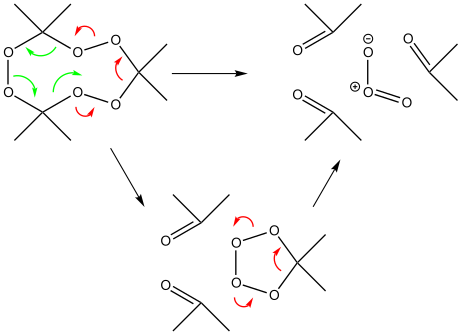
Read the rest of this entry »
References
- F. Dubnikova, R. Kosloff, J. Almog, Y. Zeiri, R. Boese, H. Itzhaky, A. Alt, and E. Keinan, "Decomposition of Triacetone Triperoxide Is an Entropic Explosion", Journal of the American Chemical Society, vol. 127, pp. 1146-1159, 2005. https://doi.org/10.1021/ja0464903
Tags: free energy, lower energy saddle point, Reaction Mechanism
Posted in Interesting chemistry | No Comments »
November 10th, 2012
Thalidomide is a chiral molecule, which was sold in the 1960s as a sedative in its (S,R)-racemic form. The tragedy was that the (S)-isomer was tetragenic, and only the (R) enantiomer acts as a sedative. What was not appreciated at the time is that interconversion of the (S)- and (R) forms takes place quite quickly in aqueous media. Nowadays, quantum modelling can provide good in-silico estimates of the (free) energy barriers for such processes, which in this case is a simple keto-enol tautomerism. In a recently published article[1], just such a simulation is reported. By involving two explicit water molecules in the transition state, an (~enthalpic) barrier of 27.7 kcal/mol was obtained. The simulation was conducted just with two water molecules acting as solvent, and without any additional continuum solvation applied. So I thought I would re-evaluate this result by computing it at the ωB97XD/6-311G(d,p)/SCRF=water level (a triple-ζ basis set rather than the double-ζ used before[1]), and employing a dispersion-corrected DFT method rather than B3LYP. 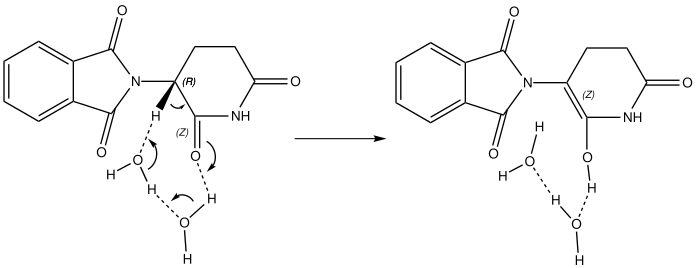
Read the rest of this entry »
References
- C. Tian, P. Xiu, Y. Meng, W. Zhao, Z. Wang, and R. Zhou, "Enantiomerization Mechanism of Thalidomide and the Role of Water and Hydroxide Ions", Chemistry – A European Journal, vol. 18, pp. 14305-14313, 2012. https://doi.org/10.1002/chem.201202651
Tags: 298 4.7, aqueous media, ATM, energy barrier, energy barriers, free energy, Historical, Reaction Mechanism, simulation, zero-point-energy
Posted in Interesting chemistry | 1 Comment »
November 4th, 2012
The text books say that cyclohexenone A will react with a Grignard reagent by delivery of an alkyl (anion) to the carbon of the carbonyl (1,2-addition) but if dimethyl lithium cuprate is used, a conjugate 1,4-addition proceeds, to give the product B shown below. The standard explanation is that the alkyl copper is a “soft” nucleophile attacking the soft conjugate carbon, whereas the alkyl magnesium is a “hard” nucleophile attacking the hard carbonyl carbon. Is this the best explanation?
Read the rest of this entry »
Tags: metal, Reaction Mechanism, simulation, Tutorial material
Posted in Uncategorised | No Comments »
November 4th, 2012
When methyl manganese pentacarbonyl is treated with carbon monoxide in e.g. di-n-butyl ether, acetyl manganese pentacarbonyl is formed. This classic experiment conducted by Cotton (of quadruple bond fame) and Calderazzo in 1962[1] dates from an era when chemists conducted extensive kinetic analyses to back up any mechanistic speculations. Their suggested transition state is outlined below. Here I subject their speculations to a quantum mechanical “reality check“.
Read the rest of this entry »
References
- F. Calderazzo, and F.A. Cotton, "Carbon Monoxide Insertion Reactions. I. The Carbonylation of Methyl Manganese Pentacarbonyl and Decarbonylation of Acetyl Manganese Pentacarbonyl", Inorganic Chemistry, vol. 1, pp. 30-36, 1962. https://doi.org/10.1021/ic50001a008
Tags: agostic interaction, pi complex, Reaction Mechanism
Posted in Interesting chemistry | 1 Comment »
October 28th, 2012
The reaction described in the previous post (below) is an unusual example of nucleophilic attack at an sp2-carbon centre, reportedly resulting in inversion of configuration[1]. One can break it down to a sequence of up to eight individual steps, which makes teaching it far easier. But how real is that sequence?
Read the rest of this entry »
References
- T.C. Clarke, and R.G. Bergman, "Olefinic cyclization at a vinyl cation center. Inversion preference for intramolecular nucleophilic substitution by a double bond", Journal of the American Chemical Society, vol. 94, pp. 3627-3629, 1972. https://doi.org/10.1021/ja00765a062
Tags: immediate product, inversion, Reaction Mechanism, triflate leaving, Tutorial material, vinyl carbocation
Posted in Interesting chemistry | 1 Comment »
October 27th, 2012
The reaction below plays a special role in my career. As a newly appointed researcher (way back now), I was asked to take tutorial groups for organic chemistry as part of my duties. I sat down to devise a suitable challenge for the group, and came upon the following reaction[1]. I wrote it down on page 2 of my tutorial book, which I still have. I continue to use this example in tutorials to this day, some 35 years later.
Read the rest of this entry »
References
- T.C. Clarke, and R.G. Bergman, "Olefinic cyclization at a vinyl cation center. Inversion preference for intramolecular nucleophilic substitution by a double bond", Journal of the American Chemical Society, vol. 94, pp. 3627-3629, 1972. https://doi.org/10.1021/ja00765a062
Tags: chemical knowledge, Reaction Mechanism, researcher, Tutorial material
Posted in Uncategorised | 1 Comment »
October 17th, 2012
Every once in a while, one encounters a molecule which instantly makes an interesting point. Thus Ruthenium is ten electrons short of completing an 18-electron shell, and it can form a complex with benzene on one face and a ligand known as trimethylenemethane on the other[1].
Read the rest of this entry »
References
- G.E. Herberich, and T.P. Spaniol, "Trimethylenemethane complexes of ruthenium via the trimethylenemethane dianion", Journal of the Chemical Society, Chemical Communications, pp. 1457, 1991. https://doi.org/10.1039/c39910001457
Tags: Iron complex, metal, Postscript
Posted in Interesting chemistry | No Comments »
October 14th, 2012
I occasionally delve into the past I try to understand how we got to our present understanding of chemistry. Thus curly arrow mechanistic notation can be traced back to around 1924, with style that bifurcated into two common types used nowadays (on which I have commented and about which further historical light at the end of this post). Here I try to combine these themes with some analysis of wavefunctions for a particularly troublesome reaction to represent, the dibromination of an alkene, which I represented in the previous post as shown below.
Read the rest of this entry »
Tags: Alan Dronsfield, donor-acceptor interaction energy, Gould, Reaction Mechanism, Tutorial material
Posted in Curly arrows | No Comments »
October 14th, 2012
There is often a disconnect between how a text-book (schematically) represents a reaction and a more quantitive “reality” revealed by quantum mechanics. Is the bromination of ethene to give 1,2-dibromoethane one such example?
Read the rest of this entry »
Tags: energy, fairly simple model for the reaction between bromine and ethene, ionic systems, kcal/mol MORE stable, lowest energy pathway, Tutorial material
Posted in Interesting chemistry | 5 Comments »