Archive for November, 2013
Saturday, November 23rd, 2013
Mercury (IV) tetrafluoride attracted much interest when it was reported in 2007[1] as the first instance of the metal being induced to act as a proper transition element (utilising d-electrons for bonding) rather than a post-transition main group metal (utilising just s-electrons) for which the HgF2 dihalide would be more normal (“Is mercury now a transition element?”[2]). Perhaps this is the modern equivalent of transmutation! Well, now we have new speculation about how to induce the same sort of behaviour for caesium; might it form CsF3 (at high pressures) rather than the CsF we would be more familiar with.[3] Here I report some further calculations inspired by this report.
(more…)
References
- X. Wang, L. Andrews, S. Riedel, and M. Kaupp, "Mercury Is a Transition Metal: The First Experimental Evidence for HgF<sub>4</sub>", Angewandte Chemie International Edition, vol. 46, pp. 8371-8375, 2007. https://doi.org/10.1002/anie.200703710
- M. Miao, "Caesium in high oxidation states and as a p-block element", Nature Chemistry, vol. 5, pp. 846-852, 2013. https://doi.org/10.1038/nchem.1754
Tags:animation, energy, free energy barrier, free energy change, metal, pence, post-transition main group metal, potential energy surface
Posted in Hypervalency, Interesting chemistry | 13 Comments »
Wednesday, November 13th, 2013
Not long ago, I described a cyclic carbene in which elevating the carbene lone pair into a π-system transformed it from a formally 4n-antiaromatic π-cycle into a 4n+2 aromatic π-cycle. From an entirely different area of chemistry, another example of this behaviour emerges; Schreiner’s[1] trapping and reactions of t-butyl-hydroxycarbene, as described on Steve Bachrach’s blog. A point I often make is that chemistry is all about connections, and so here I will discuss such a connection.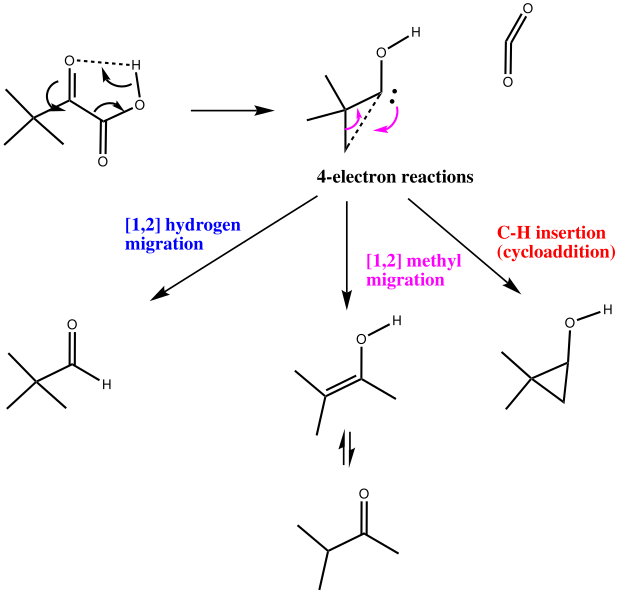
(more…)
References
- D. Ley, D. Gerbig, and P.R. Schreiner, "Tunneling control of chemical reactions: C–H insertion versus H-tunneling in tert-butylhydroxycarbene", Chem. Sci., vol. 4, pp. 677-684, 2013. https://doi.org/10.1039/c2sc21555a
Tags:Steve Bachrach
Posted in pericyclic, reaction mechanism | No Comments »
Tuesday, November 5th, 2013
The concept of kinetic vs thermodynamic control of a reaction is often taught in the context of the enolisation of e.g. 1-methylcyclohexanone as induced by a base. The story goes that at low temperatures (-78°C), the rate of the sterically more hindered thermodynamic enolisation does not compete with the faster kinetic product but that at higher temperatures when an equilibrium is possible, the thermodynamically more stable tetrasubstituted enol is formed. I set out to see if this result can be modelled.
(more…)
Tags:faster kinetic product
Posted in reaction mechanism | 2 Comments »