A few posts back, I explored the “benzidine rearrangement” of diphenyl hydrazine. This reaction requires diprotonation to proceed readily, but we then discovered that replacing one NH by an O as in N,O-diphenyl hydroxylamine required only monoprotonation to undergo an equivalent facile rearrangement. So replacing both NHs by O to form diphenyl peroxide (Ph-O-O-Ph) completes this homologous series. I had speculated that PhNHOPh might exist if all traces of catalytic acid were removed, but could the same be done to PhOOPh? Not if it continues the trend and requires no prior protonation at all!
Archive for April, 2013
Why diphenyl peroxide does not exist.
Monday, April 29th, 2013How to predict the regioselectivity of epoxide ring opening.
Sunday, April 28th, 2013I recently got an email from a student asking about the best way of rationalising epoxide ring opening using some form of molecule orbitals. This reminded me of the famous experiment involving propene epoxide.[1]
References
- H.C. Chitwood, and B.T. Freure, "The Reaction of Propylene Oxide with Alcohols", Journal of the American Chemical Society, vol. 68, pp. 680-683, 1946. https://doi.org/10.1021/ja01208a047
Intermediates in oxime formation from hydroxylamine and propanone: now you see them, now you don’t.
Sunday, April 14th, 2013A recent theme here has been to subject to scrutiny well-known mechanisms supposedly involving intermediates. These transients can often involve the creation/annihilation of charge separation resulting from proton transfers, something that a cyclic mechanism can avoid. Here I revisit the formation of an oxime from hydroxylamine and propanone, but with one change. In the earlier post, I used two molecules of water to achieve the desired proton transfer. Now I look to see what effect replacing those two water molecules by a guanidine has.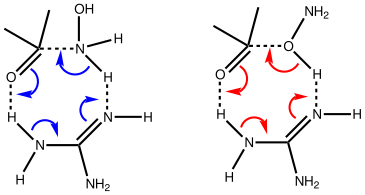
Feist’s acid. Stereochemistry galore.
Thursday, April 4th, 2013Back in the days (1893) when few compounds were known, new ones could end up being named after the discoverer. Thus Feist is known for the compound bearing his name; the 2,3 carboxylic acid of methylenecyclopropane (1, with Me replaced by CO2H). Compound 1 itself nowadays is used to calibrate chiroptical calculations[1], which is what brought it to my attention. But about four decades ago, and now largely forgotten, both 1 and the dicarboxylic acid were famous for the following rearrangement that gives a mixture of 2 and 3[2]. I thought I might here unpick some of the wonderfully subtle stereochemical analysis that this little molecule became subjected to.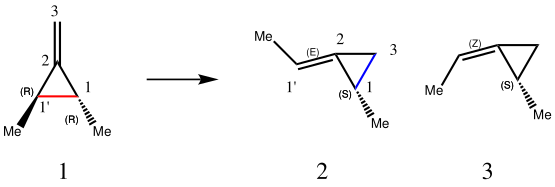
References
- E.D. Hedegård, F. Jensen, and J. Kongsted, "Basis Set Recommendations for DFT Calculations of Gas-Phase Optical Rotation at Different Wavelengths", Journal of Chemical Theory and Computation, vol. 8, pp. 4425-4433, 2012. https://doi.org/10.1021/ct300359s
- J.J. Gajewski, "Hydrocarbon thermal degenerate rearrangements. IV. Stereochemistry of the methylenecyclopropane self-interconversion. Chiral and achiral intermediates", Journal of the American Chemical Society, vol. 93, pp. 4450-4458, 1971. https://doi.org/10.1021/ja00747a019
The mechanism of ester hydrolysis via alkyl oxygen cleavage under a quantum microscope
Tuesday, April 2nd, 2013My previous dissection of the mechanism for ester hydrolysis dealt with the acyl-oxygen cleavage route (red bond). There is a much rarer[1] alternative: alkyl-oxygen cleavage (green bond) which I now place under the microscope.
References
- C.A. Bunton, and J.L. Wood, "Tracer studies on ester hydrolysis. Part II. The acid hydrolysis of tert.-butyl acetate", Journal of the Chemical Society (Resumed), pp. 1522, 1955. https://doi.org/10.1039/jr9550001522