In exploring one-electron carbon-carbon bonds, I had noted previously[1] that both hexafluoroethane and ethane itself could each lose an electron to produce such species. A discussion developed in which a molecule isoelectronic with ethane radical cation, namely the methyl-λ1-borane radical (H3B-CH3) was proposed by Jacob. The optimised structure at the ωB97XD/6-31G(d) level exhibited a B-C bond length of 1.57Å, with two of the B-H hydrogens forming a a 3c-3e bond with boron and so a one-electron B-C bond was discounted. Here I take a closer look at this system.
Archive for the ‘Interesting chemistry’ Category
A one-electron bond in methyl-λ1-borane.
Wednesday, October 9th, 2024The one-electron carbon-carbon bond: Hexafluoroethane and ethane radical cations.
Thursday, October 3rd, 2024In the previous post, I looked[1] at the recently reported[2] hexa-arylethane containing a carbon-carbon one-electron bond, its structure having been determined by x-ray diffraction (XRD). The measured C-C bond length was ~2.9aÅ and my conclusion was that the C…C region represented more of a weak “interaction” than of a bond as such. How about a much simpler system, hexafluoroethane? Here, the two-electron C-F bonds are much lower in energy than the C-C bond, so when the molecule is ionised, it escapes from the C-C bond rather than any of the C-F bonds. The below is the structure computed at the ωB97XD/Def2-TZVPP level, revealing a much shorter C-C bond of 2.149Å. The computed C-C stretching vibrational frequency is 179 cm-1 (FAIR data DOI: [3])
References
- H. Rzepa, "A carbon-carbon one-electron bond! Or a weak carbon-carbon interaction?", 2024. https://doi.org/10.59350/xp5a3-zsa24
- G.N. Lewis, "THE ATOM AND THE MOLECULE.", Journal of the American Chemical Society, vol. 38, pp. 762-785, 1916. https://doi.org/10.1021/ja02261a002
- H. Rzepa, "A carbon-carbon one-electron bond! Or a weak carbon-carbon interaction?", 2024. https://doi.org/10.14469/hpc/14642
A carbon-carbon one-electron bond! Or a weak carbon-carbon interaction?
Tuesday, October 1st, 2024More than 100 years ago, before the quantum mechanical treatment of molecules had been formulated, G. N. Lewis proposed[1] a simple model for chemical bonding that is still taught today. This is the idea of the three categories of bond we know as single, double and triple, comprising respectively two, four and six shared electrons each, at least for the very common carbon-carbon bond. A little more than a decade ago, this was extended upwards to the eight-electron quadruple bond.[2]. Now, at the other extreme of downwards, a molecule has been characterised in the solid state with a one-electron C-C bond.[3] In this sub-two-electron region, bonds such as hydrogen bonds have long been recognised and they form part of a class of “weak” bonding known instead as exhibiting “non-covalent-interactions” or NCI. But specifically a one-electron carbon-carbon bond stands apart from these weaker types and so it is certainly news when one such is reported and characterised in the crystalline state by x-ray diffraction.
References
- G.N. Lewis, "THE ATOM AND THE MOLECULE.", Journal of the American Chemical Society, vol. 38, pp. 762-785, 1916. https://doi.org/10.1021/ja02261a002
- S. Shaik, D. Danovich, W. Wu, P. Su, H.S. Rzepa, and P.C. Hiberty, "Quadruple bonding in C2 and analogous eight-valence electron species", Nature Chemistry, vol. 4, pp. 195-200, 2012. https://doi.org/10.1038/nchem.1263
- T. Shimajiri, S. Kawaguchi, T. Suzuki, and Y. Ishigaki, "Direct evidence for a carbon–carbon one-electron σ-bond", Nature, vol. 634, pp. 347-351, 2024. https://doi.org/10.1038/s41586-024-07965-1
Mechanism of the Masamune-Bergman reaction. Part 3: The transition state for Calicheamicin models.
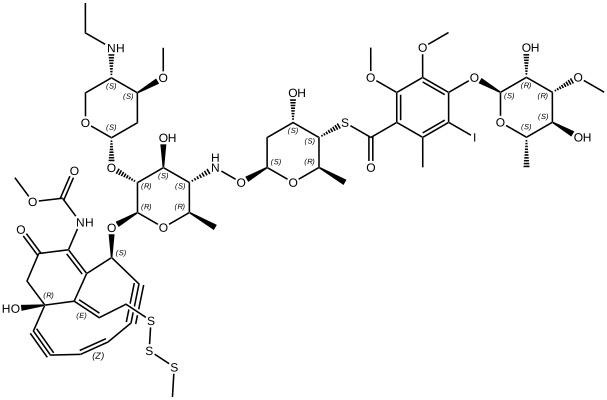
Wednesday, September 11th, 2024Calicheamicin was noted in the previous post as a natural product with antitumour properties and having many weird structural features such as an unusual “enedidyne” motif. The representation is shown below.
Mechanism of the Masamune-Bergman reaction. Part 2: a possible 3D Model for Calicheamicin revealing the non-covalent-interactions (NCI) present.
Monday, August 26th, 2024Calicheamicin is a natural product with antitumour properties discovered in the 1980s, with the structure shown below. As noted elsewhere, this structure has many weird properties, including amongst other features an unusual “enedidyne” motif and the presence of an iodo group on an aromatic ring. Its isolated 3D structure is quite difficult to get hold of (embedded structures in a DNA fragment are available however); the 3D model associated with the Wikipedia entry is essentially only in 2D. The representation shown below, including the absolute stereochemistry, was obtained from the SciFinder entry.
Mechanism of the Masamune-Bergman reaction. Part 1.
Saturday, August 24th, 2024The Masamune-Bergman reaction[1],[2] is an example of a highly unusual class of chemical mechanism[3] involving the presumed formation of the biradical species shown as Int1 below by cyclisation of a cycloenediyne reactant. Such a species is so reactive that it will be quickly trapped, as for example by dihydrobenzene to form the final product. This cycloenediyne is not just an obscure chemical curiosity, the motif is incorporated into the natural product Calicheamicin, which is a potent antitumor antibiotic discovered in the 1980s. This drug owes its activity to the cyclisation TS1 shown below, which for n=2 occurs at the low temperature of 310K. The resulting biradical Int1 is a potent hydrogen abstractor, the species acting this way for hydrogen atoms associated with deoxyribose of DNA, ultimately leading to strand scission. Although I have explored many a mechanism on this blog using computational methods, I have never included any biradical examples. Here I explore the computational aspects of this reaction, and also include a pathway proceeding vis TS2- Int2 – TS3 in which hydrogen abstraction precedes cyclisation, in order to see how competitive such an alternative might be as a function of the ring size (n in scheme below).
References
- N. Darby, C.U. Kim, J.A. Salaün, K.W. Shelton, S. Takada, and S. Masamune, "Concerning the 1,5-didehydro[10]annulene system", J. Chem. Soc. D, vol. 0, pp. 1516-1517, 1971. https://doi.org/10.1039/c29710001516
- R.R. Jones, and R.G. Bergman, "p-Benzyne. Generation as an intermediate in a thermal isomerization reaction and trapping evidence for the 1,4-benzenediyl structure", Journal of the American Chemical Society, vol. 94, pp. 660-661, 1972. https://doi.org/10.1021/ja00757a071
- R.K. Mohamed, P.W. Peterson, and I.V. Alabugin, "Concerted Reactions That Produce Diradicals and Zwitterions: Electronic, Steric, Conformational, and Kinetic Control of Cycloaromatization Processes", Chemical Reviews, vol. 113, pp. 7089-7129, 2013. https://doi.org/10.1021/cr4000682
Revisiting open/transparent peer review.
Wednesday, July 31st, 2024Back in 2017, I was asked to peer review an article and its author asked if I would like the review to be “open” – that is that my name would be shown as a reviewer; [1]10.1073/pnas.1709586114[/cite/] indeed it was!
References
How should data be cited in journal articles? A Crossref request for public comment!
Thursday, July 18th, 2024Metadata is something that goes on behind the scenes and is rarely of concern to either author or readers of scientific articles. Here I tell a story where it has rather greater exposure. For journals in science and chemistry, each article published has a corresponding metadata record, associated with the persistent identifier of the article and known to most as its DOI. The metadata contains information about the article such as its authors and their affiliations, the title of the article and its abstract, and is submitted to/registered with Crossref – an organisation set up in 1999 on behalf of publishers, libraries, research institutions and funders. Relatively recent additions to Crossref metadata are the citations included in the article, so-called Open Citations. Doing so has helped to create the new area of article metrics, used by e.g. Altmetrics or Dimensions to help identify the impacts that science publications have. Basically, if one article is cited by another, it is making an impact. Many citations of a given article by other articles means a larger impact. Most researchers love to have a high – and of course positive – impact and perhaps for better or worse, academic careers to some extent depend on such impacts.
A peak behind the (hosting) scenes of this blog.
Saturday, June 15th, 2024I should start by saying that the server on which this blog is posted was set up in June 1993. Although the physical object has been replaced a few times, and had been “virtualised” about 15 years ago, a small number of the underlying software base components may well date way back, perhaps even to 1993. This system had begun to get unreliable in recent years, and it was decided about 6 months ago to build an entirely new virtual server and then migrate stuff to it.
The 100th Anniversary year of Curly Arrows.
Friday, June 14th, 2024Chemists now use the term “curly arrows” as a language to describe the electronic rearrangements that occur when a (predominately organic) molecule transforms to another – the so called chemical reaction. It is also used to infer, via valence bond or resonance theory, what the mechanistic implications of that reaction are. It was in this latter context that the very first such usage occured in 1924[1] taking the form of a letter by Robert Robinson to the secretary of the Chemical Society and “read” on December 18th 1924. The following diagram was included:
References
- "Forthcoming events", Journal of the Society of Chemical Industry, vol. 43, pp. 1295-1298, 1924. https://doi.org/10.1002/jctb.5000435208