Archive for the ‘Interesting chemistry’ Category
Thursday, December 24th, 2015
The BBC TV quiz series Mastermind was first broadcast in the UK in 1972, the same time I was starting to investigate the mechanism of diazocoupling to substituted indoles as part of my Ph.D. researches. The BBC program became known for the catch phrase I've started so I'll finish; here I will try to follow this precept with the project I started then. 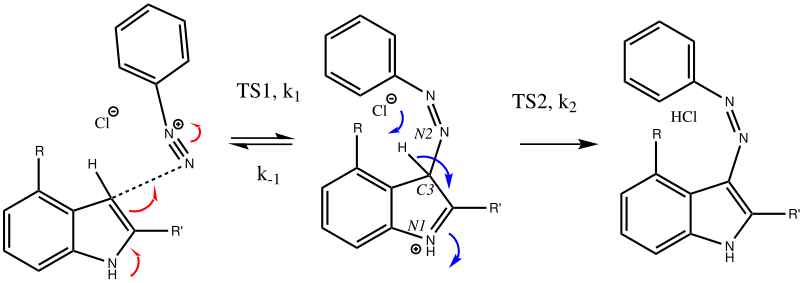 In 1972, one measured the rates of chemical reactions to gain insights into the transition state kinetic model. To obtain more data, we used isotopes such as 2H or 3H, together with substituents such as R-t-butyl to modify the potential energy surfaces of the reactions by inducing steric effects.[1],[2] We found that the kinetics for this reaction were actually complex‡ (in part because of pH dependence) involving a Wheland intermediate (the formation of which is shown with red curly arrows above) followed by the collapse of this intermediate to the diazo-coupled product (blue arrows). Coupling to 2-methyl indole (R=X=H, R'=Me), 2-t-butyl indole (R=H, R'=t-butyl) and 4-methyl-2-t-butyl indole (R=Me, R'=t-butyl) revealed that the kinetic isotope effects induced by replacing H by D or T were "not apparent" (i.e. close to 1), the inference being that the rate constant k1 for those systems was slower than k2; the formation of the Wheland intermediate was rate determining (the rds) for the reaction. But with 2-methyl-4,6-di-t-butyl indole (R=t-butyl, R'=Me) this changed and a deuterium isotope effect of ~7 was observed. The rate determining proton removal from the Wheland intermediate k2 was now slower than k1. With 2,4,6-tri-t-butyl indole, we ended by noting that the reaction become almost too slow to observe and furthermore was accompanied by loss of a t-butyl cation as well as a proton. At this point we attempted to infer some transition state models consistent with these observations. Note that we had relatively little data with which to derive our 3D models (one needs to define a geometry using 3N-6 variables, along with its relative energy and force constants). The text and diagram of our attempt is shown below.
 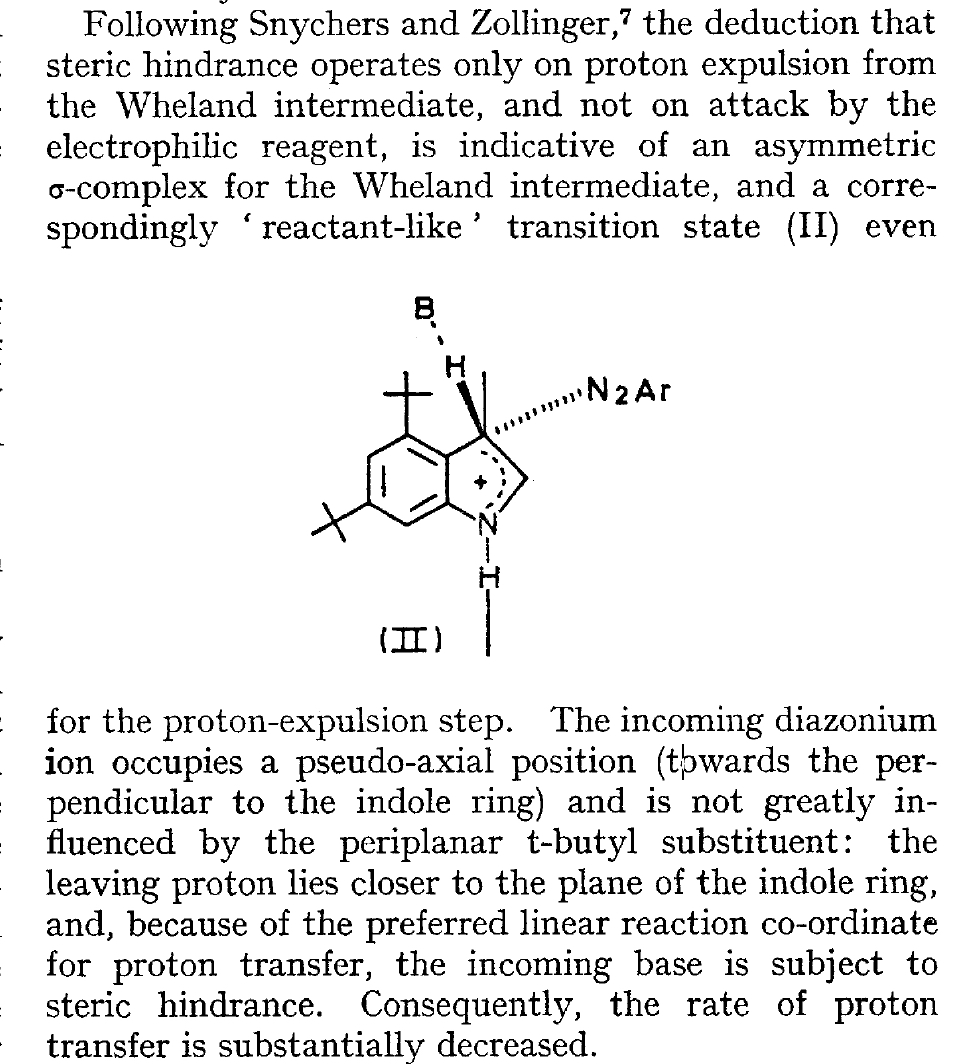 The main points of this argument were;
(more…)
References
- B.C. Challis, and H.S. Rzepa, "The mechanism of diazo-coupling to indoles and the effect of steric hindrance on the rate-limiting step", Journal of the Chemical Society, Perkin Transactions 2, pp. 1209, 1975. https://doi.org/10.1039/p29750001209
- H.S. Rzepa, "Hydrogen transfer reactions of Indoles", 1974. https://doi.org/10.5281/zenodo.18777
Tags:Butyl, chemical reactions, Indole, Kinetic isotope effect, Organic chemistry, Physical organic chemistry, potential energy surfaces, relative energy
Posted in Historical, Interesting chemistry, reaction mechanism | 1 Comment »
Friday, December 11th, 2015
You might have noticed the occasional reference here to the upcoming centenary of the publication of Gilbert N. Lewis’ famous article entitled “The atom and the molecule“.[1] A symposium exploring his scientific impact and legacy will be held in London on March 23, 2016, exactly 70 years to the day since his death. A list of the speakers and their titles is shown below; there is no attendance fee, but you must register as per the instructions below.
(more…)
References
- G.N. Lewis, "THE ATOM AND THE MOLECULE.", Journal of the American Chemical Society, vol. 38, pp. 762-785, 1916. https://doi.org/10.1021/ja02261a002
Tags:Alan Dronsfield, Clark Landis, Durham, France, Gilbert N. Lewis, John Nicholson, Julia Contreras-Garcia, Liverpool, London, Michael Mingos, Nick Greeves, organic chemist, Oxford, Patrick Coffey, professor, Robin Hendry, Royal Society of Chemistry Historical Group, United Kingdom, United States
Posted in Interesting chemistry | 1 Comment »
Thursday, December 10th, 2015
The layout of floor 2 of the chemistry department here contains a number of small rooms which function as tutorial areas. Each has a (non-interactive) whiteboard used by students and tutors for, inter-alia, thought-showering. It was in one such room that I found myself with three colleagues this monday afternoon. We soon all sensed something not quite right about the room; it slowly dawned that the whiteboard was entirely devoid of thoughts (it is normally left adorned with chemical hieroglyphics). Before we departed, one of our number crept up to the board and showered the following (the red bit only followed by a ?; thanks Willie!). The chemistry equivalent you might say of Guerrilla gardening. The product shown in blue below is for your benefit here. It is an example of a double fragmentation reaction; by an odd coincidence following on nicely from the previous post.
(more…)
Posted in Interesting chemistry, reaction mechanism | No Comments »
Saturday, November 28th, 2015
In answering tutorial problems, students often need skills in deciding how much time to spend on explaining what does not happen, as well as what does. Here I explore alternatives to the mechanism outlined in the previous post to see what computation has to say about what does (or might) not happen.
(more…)
Tags:animation, Chemical bond, condensation, Demjanov rearrangement, energy, Rearrangement reactions, Tiffeneau–Demjanov rearrangement
Posted in Interesting chemistry | No Comments »
Monday, November 23rd, 2015
This reaction emerged a few years ago (thanks Alan!) as a tutorial problem in organic chemistry, in which students had to devise a mechanism for the reaction and use this to predict the stereochemical outcome at the two chiral centres indicated with *. It originates in a brief report from R. B. Woodward’s group in 1973 describing a prostaglandin synthesis,[1] the stereochemical outcome being crucial. Here I take a look at this mechanism using computation.
(more…)
References
- R.B. Woodward, J. Gosteli, I. Ernest, R.J. Friary, G. Nestler, H. Raman, R. Sitrin, C. Suter, and J.K. Whitesell, "Novel synthesis of prostaglandin F2.alpha.", Journal of the American Chemical Society, vol. 95, pp. 6853-6855, 1973. https://doi.org/10.1021/ja00801a066
Tags:activation energy, animation, energy, learning tool
Posted in Interesting chemistry, reaction mechanism | 4 Comments »
Friday, October 23rd, 2015
Steve Bachrach on his own blog has commented on a recent article[1] discussing the structure of the trimer of fluoroethanol. Rather than the expected triangular form with three OH—O hydrogen bonds, the lowest energy form only had two such bonds, but it matched the microwave data much better. Here I explore this a bit more.
(more…)
References
- J. Thomas, X. Liu, W. Jäger, and Y. Xu, "Unusual H‐Bond Topology and Bifurcated H‐bonds in the 2‐Fluoroethanol Trimer", Angewandte Chemie International Edition, vol. 54, pp. 11711-11715, 2015. https://doi.org/10.1002/anie.201505934
Tags:Atoms in molecules, chemical bonding, Diagram, Hydrogen bond, low energy structure, lowest energy form, microwave, Steve Bachrach
Posted in Interesting chemistry | 4 Comments »
Wednesday, October 14th, 2015
In Jingdezhen an Imperial Kiln was built in 1369 to produce porcelain that was “white as jade, thin as paper, bright as a mirror and tuneful as a bell”. It’s the colours of the glazes that caught my eye, achieved by a combination of oxidative and reductive firing in the kiln, coupled with exquisite control of the temperature.
(more…)
Posted in Historical, Interesting chemistry | No Comments »
Friday, October 9th, 2015
This comes to you from China, and the city of Suzhou. To set the scene, cities in China have a lot of motorbikes. Electric ones. With their own speed units, a % of Panda speed. 
(more…)
Posted in Interesting chemistry | 1 Comment »
Thursday, October 1st, 2015
A fascinating re-examination has appeared[1] of a reaction first published[2] in 1960 by Wittig and then[3] repudiated by him in 1964 since it could not be replicated by a later student. According to the new work, the secret to a successful replication seems to be the presence of traces of a nickel catalyst (originally coming from e.g. a nickel spatula?). In this recent article[1] a mechanism for the catalytic cycle is proposed. Here I thought I might explore this mechanism using calculations to see if any further insights might emerge.
(more…)
References
- S.A. Künzi, J.M. Sarria Toro, T. den Hartog, and P. Chen, "Nickel‐Catalyzed Cyclopropanation with NMe<sub>4</sub>OTf and <i>n</i>BuLi", Angewandte Chemie International Edition, vol. 54, pp. 10670-10674, 2015. https://doi.org/10.1002/anie.201505482
- V. Franzen, and G. Wittig, "Trimethylammonium‐methylid als Methylen‐Donator", Angewandte Chemie, vol. 72, pp. 417-417, 1960. https://doi.org/10.1002/ange.19600721210
- G. Wittig, and D. Krauss, "Cyclopropanierungen bei Einwirkung von <i>N</i>‐Yliden auf Olefine", Justus Liebigs Annalen der Chemie, vol. 679, pp. 34-41, 1964. https://doi.org/10.1002/jlac.19646790106
Tags:activation free energy barriers, Cambridge, energy, energy relative, nickel-carbene product
Posted in Interesting chemistry, reaction mechanism | No Comments »
Thursday, September 24th, 2015
How does an anaesthetic work? Surprisingly, it is only recently[1] that the possible binding sites of the anaesthetic propofol (2,6-di-isopropylphenol) have been identified using a technique known as photoaffinity labelling.[2] A propofol analogue was constructed[1] by replacing one of the isopropyl groups with a trifluoromethyl diazirine group (R=CF3, X=Y=N below). Upon photolysis, this species looses nitrogen and forms a carbene as a reactive species, which with further chemistry binds covalently[2] to adjacent amino acids in the binding pocket.These modified segments could then be analysed by mass spectrometry.[1] An isomer of diazirine is diazomethane, which is some 11 kcal/mol lower in free energy, but fortunately the diazirene is preventing from thermally isomerising to this species by a large kinetic barrier. That was the intro; now for a connection.‡ I recently attended a presentation on another medical topic, the therapeutic uses of carbon monoxide.[3] In higher concentrations it is notoriously lethal, but with appropriate delivery it can be therapeutic. So, intertwingling, I asked myself what the properties of the carbon monoxide isoelectronic analogue of a diazirine might be (X=C, Y=O below).
(more…)
References
- G.M.S. Yip, Z. Chen, C.J. Edge, E.H. Smith, R. Dickinson, E. Hohenester, R.R. Townsend, K. Fuchs, W. Sieghart, A.S. Evers, and N.P. Franks, "A propofol binding site on mammalian GABAA receptors identified by photolabeling", Nature Chemical Biology, vol. 9, pp. 715-720, 2013. https://doi.org/10.1038/nchembio.1340
- L. Dubinsky, B.P. Krom, and M.M. Meijler, "Diazirine based photoaffinity labeling", Bioorganic & Medicinal Chemistry, vol. 20, pp. 554-570, 2012. https://doi.org/10.1016/j.bmc.2011.06.066
- R. Motterlini, and L.E. Otterbein, "The therapeutic potential of carbon monoxide", Nature Reviews Drug Discovery, vol. 9, pp. 728-743, 2010. https://doi.org/10.1038/nrd3228
Tags:anaesthetic, Diazirine, GABAA receptors, photo affinity labelling, propofol
Posted in Interesting chemistry, reaction mechanism | No Comments »