Archive for the ‘Interesting chemistry’ Category
Wednesday, July 8th, 2015
Peter Edwards has just given the 2015 Hofmann lecture here at Imperial on the topic of solvated electrons. An organic chemist knows this species as “e–” and it occurs in ionic compounds known as electrides; chloride = the negative anion of a chlorine atom, hence electride = the negative anion of an electron. It struck me how very odd these molecules are and so I thought I might share here some properties I computed after the lecture for a specific electride known as GAVKIS.[1] If you really want to learn (almost) everything about these strange species, go read the wonderful review by Zurek, Edwards and Hoffmann,[2] including a lesson in the history of chemistry stretching back almost 200 years.
(more…)
References
- D.L. Ward, R.H. Huang, and J.L. Dye, "Structures of alkalides and electrides. I. Structure of potassium cryptand[2.2.2] electride", Acta Crystallographica Section C Crystal Structure Communications, vol. 44, pp. 1374-1376, 1988. https://doi.org/10.1107/s0108270188002847
- E. Zurek, P. Edwards, and R. Hoffmann, "A Molecular Perspective on Lithium–Ammonia Solutions", Angewandte Chemie International Edition, vol. 48, pp. 8198-8232, 2009. https://doi.org/10.1002/anie.200900373
Posted in Interesting chemistry | 87 Comments »
Friday, May 22nd, 2015
As I have noted elsewhere, Gilbert N. Lewis wrote a famous paper entitled “the atom and the molecule“, the centenary of which is coming up.[1] In a short and rarely commented upon remark, he speculates about the shared electron pair structure of acetylene, R-X≡X-R (R=H, X=C). It could, he suggests, take up three forms. H-C:::C-H and two more which I show as he drew them. The first of these would now be called a bis-carbene and the second a biradical.
(more…)
References
- G.N. Lewis, "THE ATOM AND THE MOLECULE.", Journal of the American Chemical Society, vol. 38, pp. 762-785, 1916. https://doi.org/10.1021/ja02261a002
Tags:Carbene, Carbenes, Chemistry, Cluster chemistry, food, Functional groups, Gilbert N. Lewis, Non-Kekulé molecule, Organic chemistry, Organic compounds
Posted in Chemical IT, Historical, Interesting chemistry | 1 Comment »
Friday, March 20th, 2015
This might be seen as cranking a handle by producing yet more examples of acids ionised by a small number of water molecules. I justify it (probably only to myself) as an exercise in how a scientist might approach a problem, and how it linearly develops with time, not necessarily in the directions first envisaged. A conventional scientific narrative published in a conventional journal tells the story often with the benefit of hindsight, but rarely how the project actually unfolded chronologically.‡ So by devoting 7 posts to this, you can judge for yourself how my thoughts might have developed (and I am prepared to acknowledge this may only serve to show my ignorance).
(more…)
Tags:Mt. Everest, scientist
Posted in Interesting chemistry | No Comments »
Tuesday, March 17th, 2015
I do not play poker,‡ and so I had to look up a 5-4-3-2-1(A), which Wikipedia informs me is a 5-high straight flush, also apparently known as a steel wheel. In previous posts I have suggested acids which can be ionised by (probably) 5, 4, 3 or 1 discrete water molecules in the gas phase; now to try to track down a candidate for ionisation by the required two water molecules to form that straight flush.
(more…)
Tags:free energy, gas phase, steel wheel
Posted in Interesting chemistry | No Comments »
Sunday, March 15th, 2015
My previous posts have covered the ionization by a small number of discrete water molecules of the series of halogen acids, ranging from HI (the strongest, pKa -10) via HF (weaker, pKa 3.1) to the pseudo-halogen HCN (the weakest, pKa 9.2). Here I try out some even stronger acids to see what the least number of water molecule needed to ionize these might be.
(more…)
Tags:Christopher Reed, Ohio, pence
Posted in Interesting chemistry | 3 Comments »
Monday, March 2nd, 2015
HCN is a weak acid (pKa +9.2, weaker than e.g. HF), although it does have an isomer, isocyanic acid or HNC (pka < +9.2 ?) which is simultaneously stronger and less stable. I conclude my halide acid series by investigating how many water molecules (in gas phase clusters) are required for ionisation of this “pseudo-halogen” acid.
(more…)
Tags:ionic systems
Posted in General, Interesting chemistry | No Comments »
Saturday, February 14th, 2015
According to Guggemos, Slavicek and Kresin, about 5-6![1]. This is one of those simple ideas, which is probably quite tough to do experimentally. It involved blasting water vapour through a pinhole, adding HCl and measuring the dipole-moment induced deflection by an electric field. They found “evidence for a noticeable rise in the dipole moment occurring at n≈5–6“.
(more…)
References
- N. Guggemos, P. Slavíček, and V.V. Kresin, "Electric Dipole Moments of Nanosolvated Acid Molecules in Water Clusters", Physical Review Letters, vol. 114, 2015. https://doi.org/10.1103/physrevlett.114.043401
Tags:energy, gas phase models, Java, pence, similar energy
Posted in Interesting chemistry, reaction mechanism | 1 Comment »
Tuesday, February 10th, 2015
Steganone is an unusual natural product, known for about 40 years now. The assignment of its absolute configurations makes for an interesting, on occasion rather confusing, and perhaps not entirely atypical story. I will start with the modern accepted stereochemical structure of this molecule, which comes in the form of two separately isolable atropisomers.
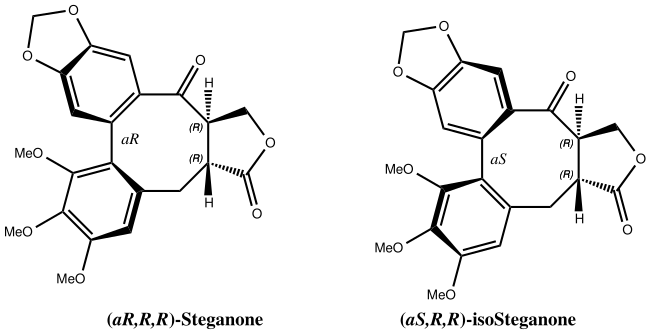
The first reported synthesis of this system in 1977 was racemic, and no stereochemistry is shown in the article (structure 2).[1] Three years later an “Asymmetric total synthesis of (-)steganone and revision of its absolute configuration” shows how the then accepted configuration (structure 1 in this article) needs to be revised to the enantiomer shown as structure 12 in the article[2] and matching the above representation. The system has continued to attract interest ever since[3],[4],[5],[6], not least because of the presence of axial chirality in the form of atropisomerism. Thus early on it was shown that the alternative atropisomer, the (aS,R,R) configuration initially emerges out of several syntheses, and has to be converted to the (aR,R,R) configuration by heating[3]. One could easily be fooled by such isomerism!
(more…)
References
- D. Becker, L.R. Hughes, and R.A. Raphael, "Total synthesis of the antileukaemic lignan (±)-steganacin", J. Chem. Soc., Perkin Trans. 1, pp. 1674-1681, 1977. https://doi.org/10.1039/p19770001674
- J. Robin, O. Gringore, and E. Brown, "Asymmetric total synthesis of the antileukaemic lignan precursor (-)steganone and revision of its absolute configuration", Tetrahedron Letters, vol. 21, pp. 2709-2712, 1980. https://doi.org/10.1016/s0040-4039(00)78586-8
- E.R. Larson, and R.A. Raphael, "Synthesis of (–)-steganone", J. Chem. Soc., Perkin Trans. 1, pp. 521-525, 1982. https://doi.org/10.1039/p19820000521
- A. Bradley, W.B. Motherwell, and F. Ujjainwalla, "A concise approach towards the synthesis of steganone analogues", Chemical Communications, pp. 917-918, 1999. https://doi.org/10.1039/a900743a
- M. Uemura, A. Daimon, and Y. Hayashi, "An asymmetric synthesis of an axially chiral biaryl via an (arene)chromium complex: formal synthesis of (–)-steganone", J. Chem. Soc., Chem. Commun., vol. 0, pp. 1943-1944, 1995. https://doi.org/10.1039/c39950001943
- B. Yalcouye, S. Choppin, A. Panossian, F.R. Leroux, and F. Colobert, "A Concise Atroposelective Formal Synthesis of (–)‐Steganone", European Journal of Organic Chemistry, vol. 2014, pp. 6285-6294, 2014. https://doi.org/10.1002/ejoc.201402761
Tags:free energy, lowest energy conformation, natural product, simulation, spectroscopy, unusual natural product, X-ray
Posted in Interesting chemistry | No Comments »