Archive for the ‘Interesting chemistry’ Category
Thursday, December 20th, 2012
I have written earlier about dihydrocostunolide, and how in 1963 Corey missed spotting the electronic origins of a key step in its synthesis.[1]. A nice juxtaposition to this failed opportunity relates to Woodward’s project at around the same time to synthesize vitamin B12. The step in the synthesis that caused him to ponder is shown below.
(more…)
References
- E.J. Corey, and A.G. Hortmann, "The Total Synthesis of Dihydrocostunolide", Journal of the American Chemical Society, vol. 87, pp. 5736-5742, 1965. https://doi.org/10.1021/ja00952a037
Tags:dispersion energy, free energy, Historical, pericyclic
Posted in Interesting chemistry, pericyclic, reaction mechanism | No Comments »
Wednesday, December 19th, 2012
The Sharpless epoxidation of an allylic alcohol had a big impact on synthetic chemistry when it was introduced in the 1980s, and led the way for the discovery (design?) of many new asymmetric catalytic systems. Each achieves its chiral magic by control of the geometry at the transition state for the reaction, and the stabilizations (or destabilizations) that occur at that geometry. These in turn can originate from factors such as stereoelectronic control or simply by the overall sum of many small attractions and repulsions we call dispersion interactions. Here I take an initial look at these for the binuclear transition state shown schematically below.
(more…)
Tags:asymmetric catalytic systems, Bob Hanson, catalysis, Julia Contreras-Garcia, little web site, NCI, non-covalent-analysis, Reaction Mechanism, terminal =CH
Posted in Interesting chemistry | No Comments »
Monday, December 17th, 2012
Part one on this topic showed how a quantum mechanical model employing just one titanium centre was not successful in predicting the stereochemical outcome of the Sharpless asymmetric epoxidation. Here in part 2, I investigate whether a binuclear model might have more success. The new model is constructed using two units of Ti(OiPr)4, which are likely to assemble into a dimer such as that shown below (in this crystal structure, some of the iPr groups are perfluorinated).
(more…)
Tags:catalysis, catalytic metal centre, Enantioselective, free energy difference, Reaction Mechanism, Sharpless epoxidation, t-butyl, This free energy difference, Tutorial material
Posted in Interesting chemistry | 2 Comments »
Sunday, December 9th, 2012
Sharpless epoxidation converts a prochiral allylic alcohol into the corresponding chiral epoxide with > 90% enantiomeric excess[1],[2]. Here is the first step in trying to explain how this magic is achieved.
(more…)
References
- J.M. Klunder, S.Y. Ko, and K.B. Sharpless, "Asymmetric epoxidation of allyl alcohol: efficient routes to homochiral .beta.-adrenergic blocking agents", The Journal of Organic Chemistry, vol. 51, pp. 3710-3712, 1986. https://doi.org/10.1021/jo00369a032
- R.M. Hanson, and K.B. Sharpless, "Procedure for the catalytic asymmetric epoxidation of allylic alcohols in the presence of molecular sieves", The Journal of Organic Chemistry, vol. 51, pp. 1922-1925, 1986. https://doi.org/10.1021/jo00360a058
Tags:animation, asymmetric epoxidation, catalysis, Enantioselective, free energy, lower energy conformations, Reaction Mechanism, Tutorial material
Posted in Interesting chemistry | 1 Comment »
Monday, November 26th, 2012
I was intrigued by one aspect of the calculated transition state for di-imide reduction of an alkene; the calculated NMR shieldings indicated an diatropic ring current at the centre of the ring, but very deshielded shifts for the hydrogen atoms being transferred. This indicated, like most thermal pericyclic reactions, an aromatic transition state. Well, one game one can play with this sort of reaction is to add a double bond. This adds quite a twist to this classical reaction!
(more…)
Tags:free energy, Möbius knot, Möbius link, pericyclic, Reaction Mechanism
Posted in Interesting chemistry | No Comments »
Tuesday, November 20th, 2012
More than 60 million molecules are known, and many are fascinating. But beauty is in the eye of the beholder. Thus it was that I came across the attached molecule[1]. It struck me immediately as, well, beautiful!
(more…)
References
- S. Lai, T. Lin, Y. Chen, C. Wang, G. Lee, M. Yang, M. Leung, and S. Peng, "Metal String Complexes: Synthesis and Crystal Structure of [Ni<sub>4</sub>(μ<sub>4</sub>-phdpda)<sub>4</sub>] and [Ni<sub>7</sub>(μ<sub>7</sub>-teptra)<sub>4</sub>Cl<sub>2</sub>] (H<sub>2</sub>phdpda = <i>N</i>-Phenyldipyridyldiamine and H<sub>3</sub>teptra = Tetrapyridyltriamine)", Journal of the American Chemical Society, vol. 121, pp. 250-251, 1998. https://doi.org/10.1021/ja982065w
Tags:metal wire
Posted in Interesting chemistry | 2 Comments »
Sunday, November 18th, 2012
A game chemists often play is to guess the mechanism for any given reaction. I thought I would give it a go for the decomposition of the tris-peroxide shown below. This reaction is known to (rapidly, very rapidly) result in the production of three molecules of propanone, one of ozone and a lot of entropy (but not heat).[1]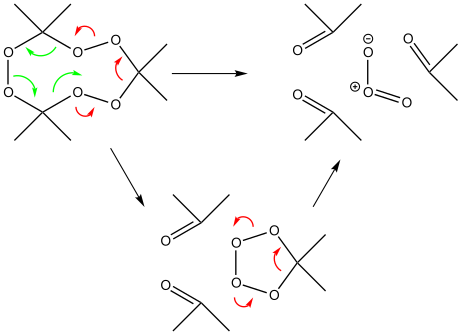
(more…)
References
- F. Dubnikova, R. Kosloff, J. Almog, Y. Zeiri, R. Boese, H. Itzhaky, A. Alt, and E. Keinan, "Decomposition of Triacetone Triperoxide Is an Entropic Explosion", Journal of the American Chemical Society, vol. 127, pp. 1146-1159, 2005. https://doi.org/10.1021/ja0464903
Tags:free energy, lower energy saddle point, Reaction Mechanism
Posted in Interesting chemistry | No Comments »
Saturday, November 10th, 2012
Thalidomide is a chiral molecule, which was sold in the 1960s as a sedative in its (S,R)-racemic form. The tragedy was that the (S)-isomer was tetragenic, and only the (R) enantiomer acts as a sedative. What was not appreciated at the time is that interconversion of the (S)- and (R) forms takes place quite quickly in aqueous media. Nowadays, quantum modelling can provide good in-silico estimates of the (free) energy barriers for such processes, which in this case is a simple keto-enol tautomerism. In a recently published article[1], just such a simulation is reported. By involving two explicit water molecules in the transition state, an (~enthalpic) barrier of 27.7 kcal/mol was obtained. The simulation was conducted just with two water molecules acting as solvent, and without any additional continuum solvation applied. So I thought I would re-evaluate this result by computing it at the ωB97XD/6-311G(d,p)/SCRF=water level (a triple-ζ basis set rather than the double-ζ used before[1]), and employing a dispersion-corrected DFT method rather than B3LYP. 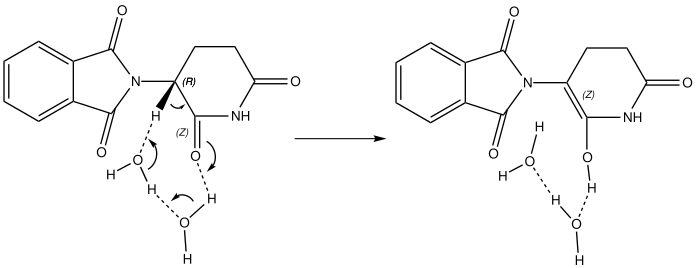
(more…)
References
- C. Tian, P. Xiu, Y. Meng, W. Zhao, Z. Wang, and R. Zhou, "Enantiomerization Mechanism of Thalidomide and the Role of Water and Hydroxide Ions", Chemistry – A European Journal, vol. 18, pp. 14305-14313, 2012. https://doi.org/10.1002/chem.201202651
Tags:298 4.7, aqueous media, ATM, energy barrier, energy barriers, free energy, Historical, Reaction Mechanism, simulation, zero-point-energy
Posted in Interesting chemistry | 1 Comment »
Sunday, November 4th, 2012
When methyl manganese pentacarbonyl is treated with carbon monoxide in e.g. di-n-butyl ether, acetyl manganese pentacarbonyl is formed. This classic experiment conducted by Cotton (of quadruple bond fame) and Calderazzo in 1962[1] dates from an era when chemists conducted extensive kinetic analyses to back up any mechanistic speculations. Their suggested transition state is outlined below. Here I subject their speculations to a quantum mechanical “reality check“.
(more…)
References
- F. Calderazzo, and F.A. Cotton, "Carbon Monoxide Insertion Reactions. I. The Carbonylation of Methyl Manganese Pentacarbonyl and Decarbonylation of Acetyl Manganese Pentacarbonyl", Inorganic Chemistry, vol. 1, pp. 30-36, 1962. https://doi.org/10.1021/ic50001a008
Tags:agostic interaction, pi complex, Reaction Mechanism
Posted in Interesting chemistry | 1 Comment »
Sunday, October 28th, 2012
The reaction described in the previous post (below) is an unusual example of nucleophilic attack at an sp2-carbon centre, reportedly resulting in inversion of configuration[1]. One can break it down to a sequence of up to eight individual steps, which makes teaching it far easier. But how real is that sequence?
(more…)
References
- T.C. Clarke, and R.G. Bergman, "Olefinic cyclization at a vinyl cation center. Inversion preference for intramolecular nucleophilic substitution by a double bond", Journal of the American Chemical Society, vol. 94, pp. 3627-3629, 1972. https://doi.org/10.1021/ja00765a062
Tags:immediate product, inversion, Reaction Mechanism, triflate leaving, Tutorial material, vinyl carbocation
Posted in Interesting chemistry | 1 Comment »