Archive for the ‘Interesting chemistry’ Category
Sunday, November 4th, 2012
When methyl manganese pentacarbonyl is treated with carbon monoxide in e.g. di-n-butyl ether, acetyl manganese pentacarbonyl is formed. This classic experiment conducted by Cotton (of quadruple bond fame) and Calderazzo in 1962[1] dates from an era when chemists conducted extensive kinetic analyses to back up any mechanistic speculations. Their suggested transition state is outlined below. Here I subject their speculations to a quantum mechanical “reality check“.
(more…)
References
- F. Calderazzo, and F.A. Cotton, "Carbon Monoxide Insertion Reactions. I. The Carbonylation of Methyl Manganese Pentacarbonyl and Decarbonylation of Acetyl Manganese Pentacarbonyl", Inorganic Chemistry, vol. 1, pp. 30-36, 1962. https://doi.org/10.1021/ic50001a008
Tags:agostic interaction, pi complex, Reaction Mechanism
Posted in Interesting chemistry | 1 Comment »
Sunday, October 28th, 2012
The reaction described in the previous post (below) is an unusual example of nucleophilic attack at an sp2-carbon centre, reportedly resulting in inversion of configuration[1]. One can break it down to a sequence of up to eight individual steps, which makes teaching it far easier. But how real is that sequence?
(more…)
References
- T.C. Clarke, and R.G. Bergman, "Olefinic cyclization at a vinyl cation center. Inversion preference for intramolecular nucleophilic substitution by a double bond", Journal of the American Chemical Society, vol. 94, pp. 3627-3629, 1972. https://doi.org/10.1021/ja00765a062
Tags:immediate product, inversion, Reaction Mechanism, triflate leaving, Tutorial material, vinyl carbocation
Posted in Interesting chemistry | 1 Comment »
Wednesday, October 17th, 2012
Every once in a while, one encounters a molecule which instantly makes an interesting point. Thus Ruthenium is ten electrons short of completing an 18-electron shell, and it can form a complex with benzene on one face and a ligand known as trimethylenemethane on the other[1].
(more…)
References
- G.E. Herberich, and T.P. Spaniol, "Trimethylenemethane complexes of ruthenium via the trimethylenemethane dianion", Journal of the Chemical Society, Chemical Communications, pp. 1457, 1991. https://doi.org/10.1039/c39910001457
Tags:Iron complex, metal, Postscript
Posted in Interesting chemistry | No Comments »
Monday, October 8th, 2012
Metathesis reactions are a series of catalysed transformations which transpose the atoms in alkenes or alkynes. Alkyne metathesis is closely related to the same reaction for alkenes, and one catalyst that is specific to alkynes was introduced by Schrock (who with Grubbs won the Nobel prize for these discoveries) and is based on tungsten (M=W(OR)3).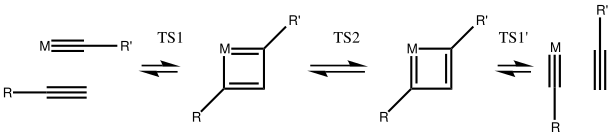
(more…)
Tags:Reaction Mechanism, X-ray
Posted in Interesting chemistry | No Comments »
Monday, September 17th, 2012
I am following up on one unfinished thread in my previous post; a candidate was proposed in which the transition state for [3,3] sigmatropic rearrangement in a semibullvalene might be frozen out to become instead a stable minimum.
(more…)
Tags:pericyclic
Posted in Interesting chemistry | 2 Comments »
Saturday, September 15th, 2012
Semibullvalene is an unsettling molecule. Whilst it has a classical structure describable by a combination of Lewis-style two electron and four electron bonds, its NMR behaviour reveals it to be highly fluxional. This means that even at low temperatures, the position of these two-electron bonds rapidly shifts in the equilibrium shown below. Nevertheless, this dynamic behaviour can be frozen out at sufficiently low temperatures. But the barrier was sufficiently low that a challenge was set; could one achieve a system in which the barrier was removed entirely, to freeze out the coordinates of the molecule into a structure where the transition state (shown at the top) became instead a true minimum (bottom)? A similar challenge had been set for freezing out the transition state for the Sn2 reaction into a minimum, the topic also of a more recent post here. Here I explore how close we might be to achieving inversion of the semibullvalene [3,3] sigmatropic potential.
(more…)
Tags:candidate for synthesis perhaps, energy, pericyclic, Postscript, Reaction Mechanism
Posted in Interesting chemistry | 3 Comments »