Archive for the ‘crystal_structure_mining’ Category
Sunday, April 9th, 2017
Both the cyclopropenium cation and the cyclopentadienide anion are well-known 4n+2-type aromatic ions, but could the two together form an ion-pair?
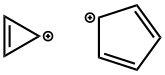
(more…)
Tags:Anions, Aromatization, Cation–pi interaction, Chemistry, Cyclopentadienyl anion, Ion, Ion association, potential energy surface, Simple aromatic rings
Posted in crystal_structure_mining, Interesting chemistry | 6 Comments »
Thursday, April 6th, 2017
Enols are simple compounds with an OH group as a substituent on a C=C double bond and with a very distinct conformational preference for the OH group. Here I take a look at this preference as revealed by crystal structures, with the theoretical explanation.
(more…)
Tags:Chemical bond, chemical bonding, Chemistry, Conformational isomerism, constrained search, Enol, free energy, Gauche effect, Hydrogen bond, Isomerism, Java, Physical organic chemistry, search query, Stereochemistry, Supramolecular chemistry
Posted in crystal_structure_mining, reaction mechanism | 2 Comments »
Saturday, April 1st, 2017
In a comment appended to an earlier post, I mused about the magnitude of the force constant relating to the interconversion between a classical and a non-classical structure for the norbornyl cation. Most calculations indicate the force constant for an “isolated” symmetrical cation is +ve, which means it is a true minimum and not a transition state for a [1,2] shift. The latter would have been required if the species equilibrated between two classical carbocations. I then pondered what might happen to both the magnitude and the sign of this force constant if various layers of solvation and eventually a counter-ion were to be applied to the molecule, so that a bridge of sorts between the different states of solid crystals, superacid and aqueous solutions might be built.
(more…)
Tags:Carbocations, chemical bonding, Chemistry, constant matrix/search direction, continuum model for water, gas phase, Paul Schleyer, Physical organic chemistry, potential energy surface, Reactive intermediates, superacid and aqueous solutions
Posted in crystal_structure_mining, Interesting chemistry, reaction mechanism | 7 Comments »
Saturday, March 25th, 2017
A few years back I followed a train of thought here which ended with hexacoordinate carbon, then a hypothesis rather than a demonstrated reality. That reality was recently confirmed via a crystal structure, DOI:10.5517/CCDC.CSD.CC1M71QM[1]. Here is a similar proposal for penta-coordinate nitrogen.
(more…)
References
- M. Malischewski, and K. Seppelt, "Crystal Structure Determination of the Pentagonal‐Pyramidal Hexamethylbenzene Dication C<sub>6</sub>(CH<sub>3</sub>)<sub>6</sub><sup>2+</sup>", Angewandte Chemie International Edition, vol. 56, pp. 368-370, 2016. https://doi.org/10.1002/anie.201608795
Tags:aromatic systems, Chemistry, Hexacoordinate, Hypotheses, Matter, Molecular geometry, Stereochemistry
Posted in Bond slam, crystal_structure_mining, Hypervalency, Interesting chemistry | 1 Comment »
Thursday, March 23rd, 2017
It is not only the non-classical norbornyl cation that has proved controversial in the past. A colleague mentioned at lunch (thanks Paul!) that tri-coordinate group 14 cations such as R3Si+ have also had an interesting history.[1] Here I take a brief look at some of these systems.
(more…)
References
- J.B. Lambert, Y. Zhao, H. Wu, W.C. Tse, and B. Kuhlmann, "The Allyl Leaving Group Approach to Tricoordinate Silyl, Germyl, and Stannyl Cations", Journal of the American Chemical Society, vol. 121, pp. 5001-5008, 1999. https://doi.org/10.1021/ja990389u
Tags:2-Norbornyl cation, Carbocations, chemical bonding, Chemistry, metal, Physical organic chemistry, Reactive intermediates, search query, tri-coordinate
Posted in crystal_structure_mining | 10 Comments »
Sunday, March 19th, 2017
The Wikipedia entry on peroxydisulfate is quite short (as of today). But I suspect this article may change things.[1].
(more…)
References
- M.A. Keller, D. Kampjut, S.A. Harrison, and M. Ralser, "Sulfate radicals enable a non-enzymatic Krebs cycle precursor", Nature Ecology & Evolution, vol. 1, 2017. https://doi.org/10.1038/s41559-017-0083
Tags:metal salts, Peroxydisulfate
Posted in crystal_structure_mining, Interesting chemistry | No Comments »
Sunday, March 19th, 2017
A pyrophoric metal is one that burns spontaneously in oxygen; I came across this phenomenon as a teenager doing experiments at home. Pyrophoric iron for example is prepared by heating anhydrous iron (II) oxalate in a sealed test tube (i.e. to 600° or higher). When the tube is broken open and the contents released, a shower of sparks forms. Not all metals do this; early group metals such as calcium undergo a different reaction releasing carbon monoxide and forming calcium carbonate and not the metal itself. Here as a prelude to the pyrophoric reaction proper, I take a look at this alternative mechanism using calculations.
(more…)
Tags:Aluminium, calculated free energy barrier, Carbon monoxide, Chemical elements, Chemistry, higher activation energy, Iron, Matter, metal, metal oxalates, Oxide, pyrophoric metal, Pyrophoricity, Reducing agents
Posted in crystal_structure_mining, reaction mechanism | 1 Comment »
Friday, March 10th, 2017
A few years back, I did a post about the Pirkle reagent[1] and the unusual π-facial hydrogen bonding structure[2] it exhibits. For the Pirkle reagent, this bonding manifests as a close contact between the acidic OH hydrogen and the edge of a phenyl ring; the hydrogen bond is off-centre from the middle of the aryl ring. Here I update the topic, with a new search of the CSD (Cambridge structure database), but this time looking at the positional preference of that bond and whether it is on or off-centre.
(more…)
References
- H.S. Rzepa, M.L. Webb, A.M.Z. Slawin, and D.J. Williams, "? Facial hydrogen bonding in the chiral resolving agent (S)-2,2,2-trifluoro-1-(9-anthryl)ethanol and its racemic modification", Journal of the Chemical Society, Chemical Communications, pp. 765, 1991. https://doi.org/10.1039/c39910000765
- H.S. Rzepa, M.H. Smith, and M.L. Webb, "A crystallographic AM1 and PM3 SCF-MO investigation of strong OH ⋯π-alkene and alkyne hydrogen bonding interactions", J. Chem. Soc., Perkin Trans. 2, pp. 703-707, 1994. https://doi.org/10.1039/p29940000703
Tags:Ammonia, Ammonium, aromaticity, Cations, Centroid, chemical bonding, Chemistry, Hydrogen bond, Phenyl group
Posted in crystal_structure_mining | No Comments »
Sunday, March 5th, 2017
Cyclobutadiene is one of those small iconic molecules, the transience and instability of which was explained theoretically long before it was actually detected in 1965.[1] Given that instability, I was intrigued as to how many crystal structures might have been reported for this ring system, along with the rather more stable congener cyclo-octatetraene. Here is what I found.
(more…)
References
- L. Watts, J.D. Fitzpatrick, and R. Pettit, "Cyclobutadiene", Journal of the American Chemical Society, vol. 87, pp. 3253-3254, 1965. https://doi.org/10.1021/ja01092a049
Tags:antiaromaticity, Chemistry, cyclobutadiene, Instability, Nature, Physical organic chemistry, Physics, search query
Posted in crystal_structure_mining | 4 Comments »
Saturday, February 11th, 2017
On February 6th I was alerted to this intriguing article[1] by a phone call, made 55 minutes before the article embargo was due to be released. Gizmodo wanted to know if I could provide an (almost)† instant‡ quote. After a few days, this report of a stable compound of helium and sodium still seems impressive to me and I now impart a few more thoughts here.
(more…)
References
- X. Dong, A.R. Oganov, A.F. Goncharov, E. Stavrou, S. Lobanov, G. Saleh, G. Qian, Q. Zhu, C. Gatti, V.L. Deringer, R. Dronskowski, X. Zhou, V.B. Prakapenka, Z. Konôpková, I.A. Popov, A.I. Boldyrev, and H. Wang, "A stable compound of helium and sodium at high pressure", Nature Chemistry, vol. 9, pp. 440-445, 2017. https://doi.org/10.1038/nchem.2716
Tags:10.1038, Atom, Chemical elements, chemical phenomenon, Chemistry, Company: P. Acucar-CBD, Electride, Electron, Food Retail & Distribution - NEC, helium, Hydrogen, Matter, Oxygen, Physics, social media
Posted in Bond slam, crystal_structure_mining, Interesting chemistry | 11 Comments »