Note: This section deals only with the bronchodilating biological activity of (R)-salbutamol, as it is still debated as to whether or not (S)-salbutamol causes bronchocontraction to occur.
Salbutamol, as previously mentioned, is a drug that acts on beta2 receptors located on the surface of the smooth muscle cells lining the lung walls. A receptor is a protein molecule embedded within the cell membrane with part of its structure facing the outside of the cell. The protein surface is extremely complicated, but there is a point on the surface which has the correct shape to receive a salbutamol molecule. A 3D representation of a beta2 receptor is given below.
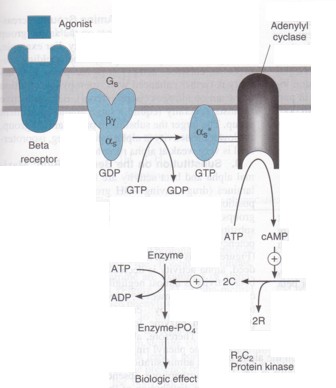
Like all adrenergic receptors, beta2 receptors are coupled with a G-protein. These proteins consist of three units: a beta unit, a gamma unit, and an alpha unit which has enzymic activity, converting GTP (guanosine 5'-triphosphate) to (GDP (guanosine 5'-diphosphate). When the beta2 receptor is not activated by a salbutamol molecule, the G-protein exists as an unattached alpha-beta-gamma trimer, with GDP occupying the site on the alpha subunit.
When a salbutamol molecule binds to a beta2 receptor, the receptor deforms, and acquires a high affinity for the G-protein. However, when the protein binds to the receptor, GDP dissociates from it and is replaced by GTP. This step leads to the G-protein breaking up, with alpha-GTP separating from the beta-gamma unit. Alpha-GTP diffuses freely through the membrane to the enzyme adenylyl cyclase, found within cells.
Alpha-GTP is capable of binding with adenylyl cyclase, activating the enzyme and prompting it to synthesise cyclic 3’,5’-adenosine monophosphate (cAMP) from adenosine 5'-triphosphate (ATP).
This synthesis of cAMP leads to the activation of protein kinase A, which phosphorylates (thus deactivates) the enzyme myosin-light-chain kinase (required for muscle contraction) and lowers intracellular ionic calcium concentrations, resulting in relaxation. Bronchodilation occurs within 15 minutes of inhalation and has an effective duration of 6 hours.
The diagram below summarises how activation of a beta2 receptor leads to a biologic effect
Thus the presence of salbutamol results in increased cAMP concentration, which leads to the relaxation of muscle tissue.