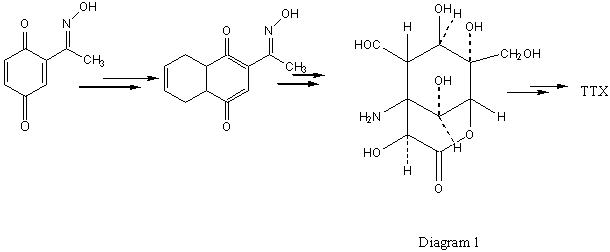
Woodward, the Kishi-Goto group and the Tsuda-Ikuma group elucidated the structure of TTX simultaneously in 1964. The racemic synthesis of TTX was accomplished by Kishi and his co-workers in1972 (Kishi, Y. et al. J. Am. Chem. Soc. 1972,94). To date the Kishi-Goto pathway is the only successful synthetic route to TTX that has been accomplished.
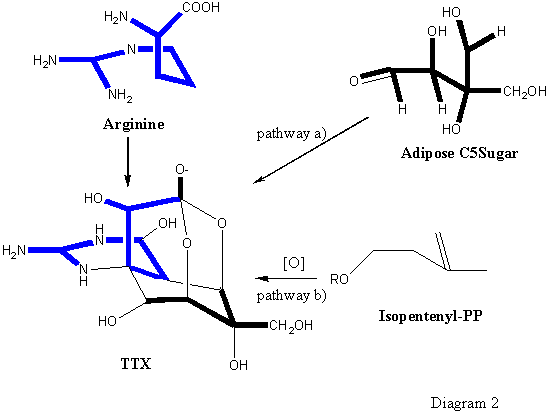
TTX is thought to be synthesized by a bacterial or dinoflagellate species associated with the puffer fish. To date little is known regarding the biosynthesis of TTX. No one has yet isolated enzymes responsible for the biosynthesis, but Kotaki and Shimizu (Journal of the American Chemical Society 115:3, 829) have put forward a hypothetical biosynthetic scheme in which either an adipose sugar or isopentenyl-PP group is linked to the amino acid Arginine.
There are several derivatives of TTX, which were obtained.They were considered to be compounds at different stages of oxidation as in the case of chiriquitoxin found in the frog Aterops chiriquiensis as seen below;
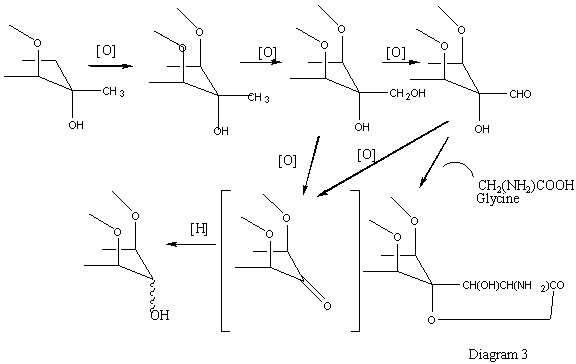
However, some of the discovered TTX derivative lacks an oxygen function on the ring. This indicates that TTX is indeed formed by the stepwise oxidation of an alicyclic system as suggested in pathway b) in Diagram 2.
The question still remains unsolved of the biological origin of the TTX, however the fact that it is often found in a variety of organisms seems that it is derived from a very common sources.