Enol Borinates in Stereospecific C-C bond
formation. Studying Asymmetric Induction
A key stage in the reaction sequence shown as part of the
problem is the following step involving C-C bond formation to
an aldehyde, mediated by the chiral auxilliary
X=di-isopinocampheyl (see I. Paterson et al,
Tetrahedron, 1990, 46, p 4663; 1991, 47,
pp. 3471-3484)
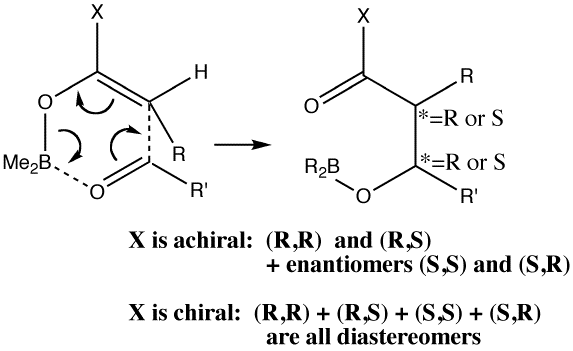
Other than the chiral auxiliary, all the reagent components
are achiral. However, two entirely new chiral centres are
formed in the product. Modelling can help us understand two
features of these new chiral centres and why they form so
specifically.
- their relative stereochemistry
- their absolute stereochemistry.
The Relative Stereochemistry
A 3D model for the basic framework (i.e. replacing all
substituents with H) of the transition state must be
constructed. Since this involves bond formation and cleavage, a
QM (Quantum Mechanics) based model must be used, in this case
the AM1 semi-empirical method (Table). The transition state can
be located using a variety of methods. Since the reaction
involves two bonds making and one breaking, its difficult to
construct a 1D or 2D grid as in the example 13 above. The
easiest way is to guess the approximate lengths of the
breaking/making bonds (about 1.9 - 2.1A), and insert this
guessed geometry into an appropriate transition state location
algorithm, such as the eigenvector following method. Whilst
rather hit and miss, after a few attempts, the algorithm should
result in transition state location. A little trick to help it
do so is to define the coordinates in internals (ie bond
lengths etc) and to ensure that the three changing bonds are
defined. Next, freeze their values at 1.9 - 2.1A and optimise
the remainder of the molecule (to remove all gradients
associated with non reacting centres). Then, release the
transition state bonds and let the TS optimiser do the rest!
These calculations reveal that both chair and boat forms of
the transition state are possible. A full calculation of the
2nd derivative matrix, followed by appropriate mass weighting,
will give the frequencies of the various normal modes of the
molecule. One is shown as -ve (imaginary), being the transition
state normal mode. A program such as JMol can be used to
animate the form of this normal mode.
| Prototypic Chair transition state |
Prototypic Boat transition state |
| |
|
One next needs to understand how the various substitution sites
interact sterically. To do this, methyl groups are inserted
into the various positions (including one for the chiral
auxilliary X) and the energies of some of the various possible
isomers are calculated. Note the following:
- The chair form () is the most stable
- The chiral centre on the aldehyde ( ) is formed with the methyl group equatorial
(), thus avoiding steric congestion from the chiral
auxilliary X () This particular steric interaction in effect
defines which π face of the carbonyl group is used to form
the new C-C bond.
- The alternative relative stereochemistry of the chiral
centre () would place the methyl group axial (). It is about 3 kcal/mol higher in energy, and
hence is not formed.
| Chair transition state |
Chair transition state isomer |
| -103.1 kcal/mol |
-100.3 kcal/mol |
|
|
Another way of avoiding steric congestion is for the boat
conformation () to form. The methyl () adopts an equatorial position, but it is eclipsed
rather than staggered with the adjacent C-H and hence the most stable boat isomer is 3 kcal/mol
higher than the chair.
| Boat transition state |
| -100.1 kcal/mol |
| |
The Absolute Stereochemistry
The methyl group X must now be replaced with a chiral
auxilliary. Many such auxiliaries can be used (most derived
from natural products that are enantiomerically pure). To start
with a simple model, will use the (un-natural) chiral group
-CHClI (), which contains three ligands of quite different
size. Its chirality is defined in these models as S. When
inserted into the model, two diastereoisomers with carbon
chirality of S,R () or R,S > can be formed. The calculations reveal that one
of these is about 3 kcal/mol more stable than the other, which
is the correct order of magnitude to result in a high degree of
chiral induction.
| Chiral S, Carbon R,S (-84.9) |
Chiral S, Carbon S,R (-87.6) |
| |
|
A "natural" chiral group can now be inserted ( ) to form the final models.
| Chiral S, RS (-149.55) |
Chiral S, SR (-152.43) |
| |
|