
Macrocyclic Exchange:
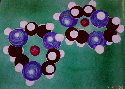
Selectivity of crown ether ionophores for small metal cations
An investigation into the 14-crown-4 structure and capability
169 1/2 South Schuyler Ave.
Kankakee, IL 60901-3807
Abstract
- Whether it be for commercial collection or ecological purification,
the competent ionophoric extraction of small metal cations is a phenomenon
worthy of investigation. Dependent upon target ion, ring radius and heteroatomic
configuration are variable factors which can be manipulated to achieve optimum
customization. The smaller crown ethers are not useless. However, it is the 14-crown-4
that has received the bulk of commendatory research. Four such structures
which have displayed extractive proficiency will be investigated. They are
found in the research of Richard Bartsch, Hiroshi Tsukube, and Shijiro Ogawa.
The optimal ionophore may yet be engineered, for none have shown unrivalled
efficiency.
Structures
Bartsch Structurea
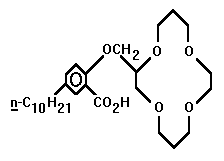 Bartsch Structureb
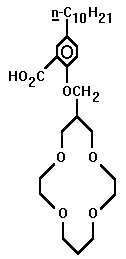
The two Bartsch 14C4 rings displayed high selectivity for the Li+
in aqueous solutions, in a study of ten rings ranging in sizes from 12C4 to 15C4.
The maximum Li+/Na+ ratio for structure a was 20, for structure b, 19.
Tsukube Structure
In a test aimed primarily at aza-12C4 structures
the Tsukube ring was named, "one of the best ionophores for
Li+ ion" (6750). The study also introduced the intriguing
idea of an amine side arm.
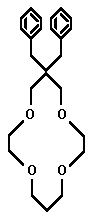
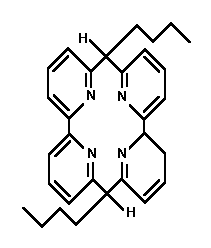
Ogawa Structure
The Ogawa azacycle was thought to demonstrate powerful selectivity
because of its inflexibility, and because the ring radius was "too small
to bind to other alkali and alkaline-earth ions" (5761). Also, oxygen
has a stronger coordination force to alkali and alkaline-earth metal ions.
Subsequently, the aza-configuration is favourable (5762).
Conclusion
The complete overall structure of the ring is important when
theorizing the flexibility of the ionophore. The nitrogen heteroatoms
may be more selective than an oxygen-dominated crown ether. The Tsukubian
amine side arm may prove more useful in regards to this aza-attractiveness,
as well. When engineered ideally, after all these factors are fine-tuned, the
smaller rings, such as the 9C3, 12C3, or 12C4, may prove more viable. The
numerous factors and variables allow the search for the ideal ring to continue.
"One ring to bring them all, and in the darkness bind them."
--J.R.R. Tolkien, The Lord of the Rings
References
Bartsch, Richard A. et al. "High lithium selectivity in competitive
alkali-metalic solvent extraction by lipophilic crown carboxylic acids."
Journ. Am. Chem. Soc. 1985. Vol. 107, pp. 4997-4998.
De Angelis, Stefania. et al. "Mono- and bis(dibenzotetramethyltetraaza[14]annulene)
complexes of group IV metals, including the structure of the lithium derivative of the macrocyclic ligand." Inorg. Chem. 1992. Vol. 31, pp. 2520-2527.
Ogawa, Shojiro. et al. "Aza macrocycle that selectively binds to lithium ion
with color change." Journ. Am. Chem. Soc. 1984. Vol. 106, pp. 5760-62.
Tsukube, Hiroshi. et al. "Amine-armed aza-12-crown-4 as a new Li+
ion-specific ionophore." Tetrahedron Letters. 1993. Vol. 34, No. 42,
pp. 6749-6752.
 Bill Brower